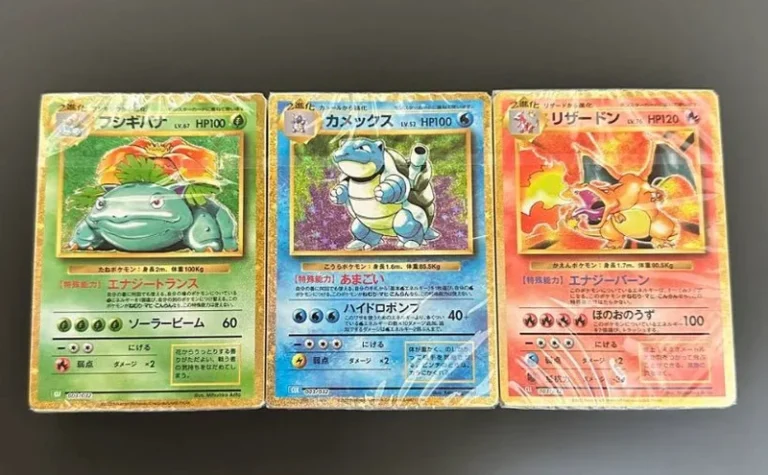
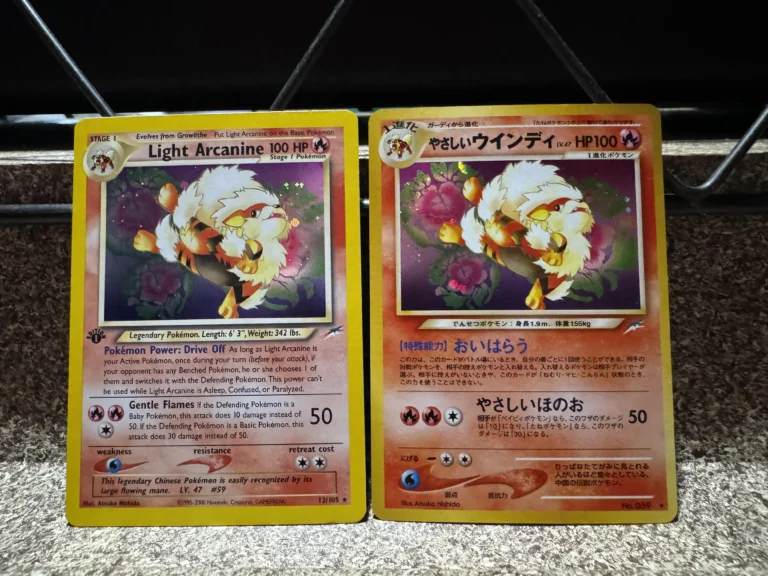
Japan has a unique relationship with Magic: The Gathering.
For more than two decades, Wizards of the Coast has released Japanese-language cards, Japan-exclusive promos, alternate-art treatments, collaborations with Japanese artists, and cards inspired by Japanese mythology, manga and popular culture.
Some of these cards are genuinely exclusive to Japan. Others were designed around Japanese art but were distributed worldwide.
That distinction is important, especially for collectors. A Japanese-language Magic card is not automatically a Japan-exclusive card, and some of the most famous Japanese MTG cards — such as the Strixhaven Mystical Archive and Kamigawa Ukiyo-e lands — were available outside Japan.
This guide looks at both sides of that story: the Japanese MTG cards that are genuinely exclusive, and the much broader world of Japanese art and culture in Magic: The Gathering.
What Makes a Magic Card Japanese-Exclusive?
There are several different ways a Magic card can have a special connection to Japan.
For this guide, a Japanese-exclusive MTG card means that the specific printing, artwork or promotional version was created for a Japanese-only release, event or product, or was printed exclusively in Japanese.
That includes:
- Japan-only promotional cards
- Japan-exclusive event promos
- Japanese-exclusive artwork
- Cards printed only in Japanese
- Special Japanese promotional versions of existing cards
It does not mean that every Japanese-language card belongs in this category.
For example, a regular Japanese copy of a card from a normal Magic set is simply a Japanese-language version. Likewise, the famous Ukiyo-e lands from Kamigawa: Neon Dynasty use Japanese-inspired artwork and Japanese text, but were distributed internationally.
That difference is one of the most important things to understand when collecting Japanese Magic cards.
Japanese-Exclusive MTG Cards
Magic Premiere Shop Promos
Some of the earliest important Japanese Magic collectibles came from the Magic Premiere Shop program.
Beginning in the mid-2000s, the program produced special promotional basic lands and other cards connected to Japanese retail and organized play. The releases continued through the following years and included distinctive artwork that is very different from ordinary basic lands.

The early releases are particularly interesting because they form a kind of parallel history of Japanese Magic collecting.
Rather than simply being Japanese translations of existing cards, these were promotional printings associated with Japan’s local Magic scene.
For collectors interested in the history of Japanese MTG cards, Magic Premiere Shop lands are one of the best places to start.
War of the Spark Japanese Alternate-Art Planeswalkers
The most famous Japanese Magic artwork project arrived with War of the Spark in 2019.
Wizards commissioned Japanese artists to create completely new artwork for the set’s 36 Planeswalkers. These alternate-art versions appeared in Japanese-language War of the Spark boosters, replacing the normal Planeswalker artwork in a significant portion of packs.
The important detail is that the alternate-art versions themselves were printed only in Japanese.

However, there is a small complication: Japanese-language boosters were made available to retailers around the world, and some of the alternate-art Planeswalkers were later distributed internationally through Promo Packs.
So these are best described as Japanese-exclusive artwork and Japanese-only printings, rather than cards that could literally only be obtained inside Japan.
The 36 Japanese Alternate-Art Planeswalkers
- Ajani, the Greathearted
- Angrath, Captain of Chaos
- Arlinn, Voice of the Pack
- Ashiok, Dream Render
- Chandra, Fire Artisan
- Davriel, Rogue Shadowmage
- Dovin, Hand of Control
- Gideon Blackblade
- Huatli, the Sun’s Heart
- Jace, Wielder of Mysteries
- Jiang Yanggu, Wildcrafter
- Jaya, Venerated Firemage
- Karn, the Great Creator
- Kasmina, Enigmatic Mentor
- Kaya, Bane of the Dead
- Kiora, Behemoth Beckoner
- Liliana, Dreadhorde General
- Nahiri, Storm of Stone
- Narset, Parter of Veils
- Nicol Bolas, Dragon-God
- Nissa, Who Shakes the World
- Ob Nixilis, the Hate-Twisted
- Ral, Storm Conduit
- Saheeli, Sublime Artificer
- Samut, Tyrant Smasher
- Sarkhan the Masterless
- Sorin, Vengeful Bloodlord
- Tamiyo, Collector of Tales
- Teferi, Time Raveler
- Teyo, the Shieldmage
- The Wanderer
- Tibalt, Rakish Instigator
- Ugin, the Ineffable
- Vivien, Champion of the Wilds
- Vraska, Swarm’s Eminence
The project became one of the defining moments in Japanese Magic collecting.
It also introduced some of the most famous Japanese Magic artwork ever printed, including Liliana, Dreadhorde General, illustrated by legendary Japanese artist Yoshitaka Amano.
Ikoria’s Japanese-Exclusive Godzilla Cards
Ikoria: Lair of Behemoths created another unusual chapter in Japanese Magic collecting.
Three Godzilla Series Monster cards ended up being exclusive to Japanese product:
- Battra, Dark Destroyer
- Mechagodzilla, the Weapon
- Mothra’s Great Cocoon
They are numbered 385, 386 and 387 within the Godzilla Series Monster cards.

Their history is particularly unusual. These cards were originally intended to appear in English and French Collector Boosters, but a production error meant that they were omitted.
Wizards subsequently distributed copies to stores as compensation, while the Japanese versions remained part of Japanese product.
That makes these cards a fascinating example of accidental exclusivity: they became Japanese-exclusive not because Wizards originally designed them that way, but because of a production mistake.
The Japanese “Onigiri” Orb of Dragonkind
Adventures in the Forgotten Realms also produced one of the most unusual Japanese Magic promos.
Japanese WPN stores received a special version of Orb of Dragonkind featuring newly commissioned artwork by Japanese illustrator Kawasumi.
The card became known as the Onigiri promo, thanks to its rice-ball-inspired artwork.
There were three different artwork versions associated with different prefectures.
It is a perfect example of a regional Magic promo: the underlying card is familiar, but the Japanese promotional printing turns it into something culturally specific.
Magic × Duel Masters
Magic’s relationship with Japanese trading-card culture produced another unusual experiment in 2023.
The Magic × Duel Masters promotion brought artwork from the Japanese Duel Masters universe back into Magic.
The promotion featured four special foil cards:
- Earthquake
- Serra Angel
- Pouncing Jaguar
- Nicol Bolas
The cards were distributed through Japan-only events and are particularly interesting because of the history between the two games.
Duel Masters was itself derived from Magic’s game system and became one of the biggest trading-card games in Japan. This promotion effectively created a visual crossover between the two games.
For collectors interested in Japanese TCG history, these cards are arguably more interesting than their individual play value would suggest.
PWS, PWFM and PWCS: Japan’s Exclusive Planeswalker Promos
One of the biggest Japanese-exclusive Magic categories is not a single set at all.
It is a continuing series of Japanese events that began as Planeswalker Championship (PWCS), later became Planeswalker Friendly Match (PWFM), and evolved into Planeswalker Series (PWS).
These events are part of Japan’s local Magic scene and have repeatedly featured promotional cards with exclusive artwork commissioned for the Japanese program.

Among the cards released through these events are:
- Pteramander
- Experimental Frenzy
- Vraska, Golgari Queen
- Narset, Parter of Veils
- Nissa, Who Shakes the World
- Liliana, Dreadhorde General
- Mystical Dispute
- Elspeth, Sun’s Nemesis
- Basri Ket
- Faceless Haven
- Kaya the Inexorable
- The Wandering Emperor
- Elspeth Resplendent
- Giada, Font of Hope
- Braids, Arisen Nightmare
- Liliana of the Veil
- Realm-Scorcher Hellkite
- Saheeli, the Sun’s Brilliance
- Kaya, Spirits’ Justice
- Jace Reawakened
- Nissa, Resurgent Animist
- Delney, Streetwise Lookout
- Slickshot Show-Off
- Beza, the Bounding Spring
- Into the Flood Maw
- The Wandering Rescuer
- Twitching Doll
- Voice of Victory
- Strategic Betrayal
The list continues to grow as new PWS seasons are held.
This makes PWS one of the most important categories for anyone specifically collecting Japan-exclusive MTG promos.
The Wandering Emperor – Summer Festival Promo
One of the most distinctive recent Japanese Magic promos features The Wandering Emperor, reimagined by Japanese illustrator Fuzichoco in a Summer Festival scene. The artwork depicts the character alongside Kaito beneath a night sky filled with fireworks, blending the world of Kamigawa: Neon Dynasty with the atmosphere of a traditional Japanese summer festival.
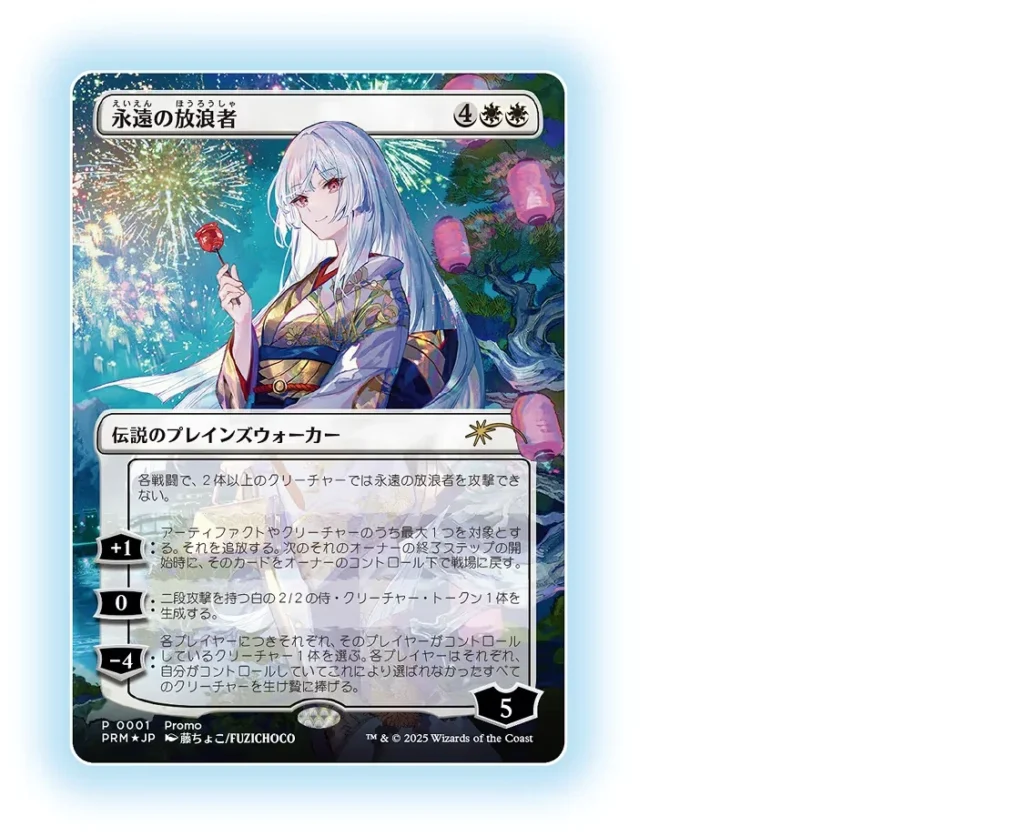
The card was part of a Japan-only promotional campaign in 2026 celebrating Fuzichoco’s The Wandering Emperor: Four Seasons artwork series. The special promo was limited to 2,000 copies, making it a particularly noteworthy release for collectors interested in Japanese-exclusive Magic cards.
Japanese Alternate-Art MTG Cards
Not every Japanese Magic card is exclusive to Japan.
Wizards has increasingly used Japanese artists, manga aesthetics and traditional Japanese art styles for cards that are distributed globally.
These cards deserve their own category because they are hugely important to Japanese Magic collecting even though they do not meet the strict definition of a Japan-exclusive card.
Strixhaven Japanese Mystical Archive
The Japanese Mystical Archive from Strixhaven: School of Mages is probably the most famous example.
The Mystical Archive contained 63 reprinted spells, and the Japanese versions received completely different artwork.
Japanese artists created illustrations inspired by manga, Japanese fantasy art and other visual traditions.
The cards were not restricted to Japan, however.
Japanese alternate-art Mystical Archive cards could be found internationally through Collector Boosters.
So these are Japanese alternate-art MTG cards, rather than Japan-exclusive cards.
They remain some of the most recognizable Japanese Magic cards ever produced.
Kamigawa: Neon Dynasty Ukiyo-e Lands
Kamigawa: Neon Dynasty took the idea even further.
The set introduced ten Ukiyo-e basic lands, with two versions of each basic land type.
The artwork deliberately draws from the Japanese woodblock-print tradition known as ukiyo-e, while the cards themselves use Japanese text.

But once again, they were not exclusive to Japanese product.
Ukiyo-e lands could appear in Kamigawa products around the world.
They are therefore better described as Japanese-themed Magic cards rather than Japanese-exclusive MTG cards.
Japan Showcase Cards
Magic has continued to produce Japanese Showcase cards in later sets.
These cards use artwork by Japanese artists and are designed around Japanese visual aesthetics, but the Japanese versions are not necessarily restricted to Japan.
They belong to the wider Japanese Magic art movement that began with projects such as War of the Spark and expanded dramatically with Kamigawa: Neon Dynasty.
Bloomburrow Japanese Raised Foil Anime Cards
Bloomburrow introduced another Japanese-inspired treatment through its Raised Foil Anime cards.
The anime-inspired artwork is strongly associated with Japanese visual culture, and the cards were produced in Japanese and English versions.

Again, the distinction matters: Japanese does not automatically mean Japan-exclusive.
These cards belong in the Japanese alternate-art and anime-inspired category rather than the strict Japan-exclusive section.
Japanese Art & Culture in Magic
This is where Japanese Magic collecting becomes much more interesting.
Wizards has not simply translated Magic into Japanese. Over the years, it has repeatedly collaborated with Japanese artists, manga creators and pop-culture properties.
Some of the best examples come from Secret Lair and Kamigawa.
Yoji Shinkawa: From Metal Gear to Magic
Few Japanese artists have a stronger connection to modern video-game design than Yoji Shinkawa.
Best known internationally for his character and mechanical designs for the Metal Gear series, Shinkawa brought his unmistakable ink-heavy style to Magic.
His most prominent Magic appearance came with Satoru Umezawa from Kamigawa: Neon Dynasty.
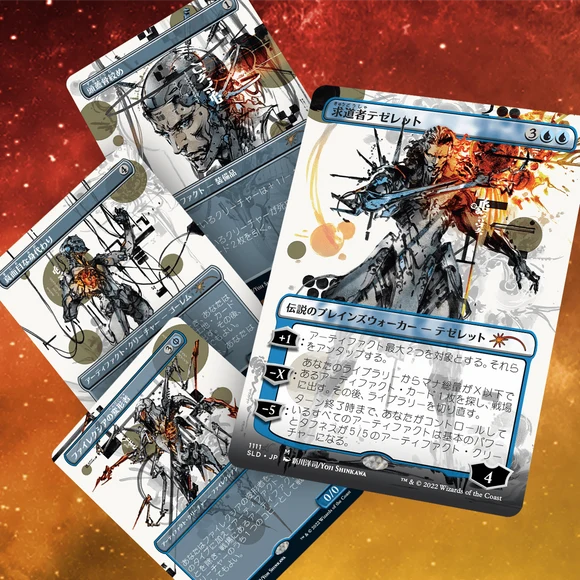
The special Buy-a-Box version of Satoru Umezawa features artwork by Shinkawa, making the card an obvious crossover between the worlds of Japanese video games and Magic.
But Shinkawa’s involvement did not stop there.
He later received his own Special Guest: Yoji Shinkawa Secret Lair, featuring:
- Tezzeret the Seeker
- Phyrexian Metamorph
- Skullclamp
- Solemn Simulacrum
The result is one of the clearest examples of Magic embracing the visual language of Japanese mecha and character design.
If you are interested in Japanese MTG cards because of the artwork rather than competitive play, Shinkawa’s cards are essential.
Junji Ito Brings Japanese Horror to Magic
If Shinkawa represents Japanese game design, Junji Ito represents another major part of Japanese visual culture: horror manga.
The legendary manga artist received a Special Guest: Junji Ito Secret Lair featuring four cards:
- Carrion Feeder
- Doomsday
- Plaguecrafter
- Thoughtseize
Ito’s distinctive black-and-white horror artwork completely changes the atmosphere of the cards.
This is more than simply hiring a famous illustrator. It is a direct collision between Magic’s dark fantasy imagery and one of Japan’s most recognizable manga traditions.
For anyone searching for Japanese anime or manga MTG cards, this is one of the most important collections to know.
Kamigawa: The Manga
Magic also turned its own Japanese-inspired setting into actual manga.
The Secret Lair Kamigawa: The Manga: The Cards contains five cards featuring artwork taken directly from the official Kamigawa: Neon Dynasty manga:
- Idyllic Tutor
- Swords to Plowshares
- Solve the Equation
- Praetor’s Grasp
- Veil of Summer
The artwork was created by RIYOU KAMEI.
The concept is wonderfully circular: Magic created a Japanese-inspired world, that world received an official manga, and scenes from that manga were then placed back onto Magic cards.
It is one of the clearest examples of Japanese manga becoming part of Magic’s own visual identity.
Pictures of the Floating World
Another Secret Lair from the same Kamigawa-era Superdrop focused directly on ukiyo-e.
Pictures of the Floating World contains five lands:
- Windbrisk Heights
- Shelldock Isle
- Howltooth Hollow
- Spinerock Knoll
- Mosswort Bridge
The cards feature artwork by TOMOHITO, AMAYAGIDO, SHIE NANAHARA, Nagano and AOJI MAIKO.

The name itself references the traditional Japanese concept of the floating world, while the artwork deliberately draws on ukiyo-e.
It is a great example of Magic using a historical Japanese art form rather than simply using anime aesthetics.
Yuko Shimizu and Modern Japanese Illustration
Japanese illustrator Yuko Shimizu has also contributed significantly to Magic.
Her Secret Lair Special Guest: Yuko Shimizu contains:
- Hokori, Dust Drinker
- Kira, Great Glass-Spinner
- Eidolon of the Great Revel
- Elvish Spirit Guide
Wizards describes Shimizu’s style as a combination of traditional Japanese art and modern concepts.

Her work is particularly interesting because it demonstrates that “Japanese Magic art” does not have to mean anime.
There is a much wider spectrum, from traditional Japanese visual language to contemporary illustration.
Tanuki and Japanese Folklore
One of the most fun recent examples is the Secret Lair Commander Deck: 20 Ways to Win.
The deck contains ten cards with completely new rainbow-foil artwork built around a tanuki trickster spirit.
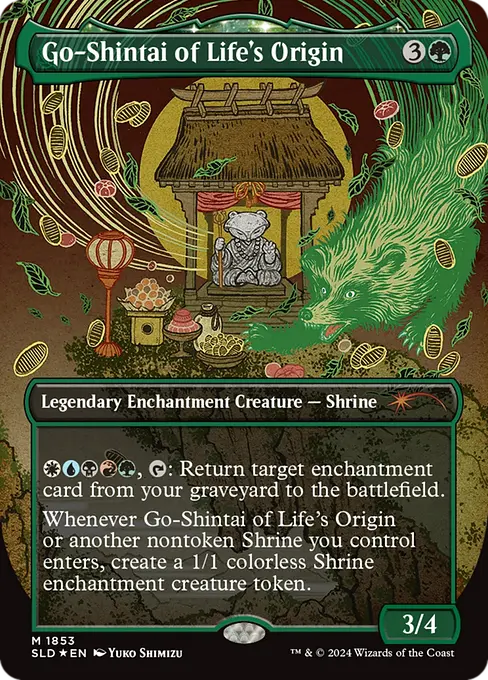
The cards include:
- Go-Shintai of Life’s Origin
- Approach of the Second Sun
- Felidar Sovereign
- Happily Ever After
- Triskaidekaphile
- Revel in Riches
- Helix Pinnacle
- Simic Ascendancy
- Sol Ring
- Maze’s End
The same tanuki theme appears on the deck’s special Shrine tokens.
This is particularly interesting for Japan Connection because the tanuki is not simply a cute animal mascot. In Japanese folklore, the tanuki is associated with shapeshifting, trickery and mischievous supernatural behavior.
Magic turns that folklore tradition into a visual theme built around cards whose entire purpose is finding unusual ways to win the game.
Hatsune Miku and Japanese Pop Culture
Japanese influence on Magic is no longer limited to traditional art and fantasy.
In 2024, Secret Lair collaborated with Hatsune Miku, the virtual singer and digital pop-culture icon.
The first release, Secret Lair x Hatsune Miku: Sakura Superstar, featured cards inspired by Miku and the imagery of a Japanese spring, including cherry blossoms and lightning.
The collaboration continued through additional drops, and Wizards eventually expanded the project into even more substantial releases.
The cards are available in English and Japanese, so they are not Japan-exclusive.
But culturally, they are about as Japanese as Magic’s modern collaborations get.
For a site focused on Japanese pop culture, Hatsune Miku is therefore much more relevant than a simple list of Japanese-language Magic cards would suggest.
Japanese Artists Who Shaped Magic
One of the easiest ways to explore Japanese Magic cards is through the artists themselves.
Some of the most important names include:
Yoji Shinkawa
Known for Metal Gear, mecha and character design.
Tetsuo Hara
The legendary illustrator behind Fist of the North Star.
Katsuya Terada
A Japanese illustrator and character designer known for work across manga, animation and film.
Junji Ito
One of Japan’s most influential horror manga artists.
Yuko Shimizu
Known for combining traditional Japanese influences with contemporary illustration.
RIYOU KAMEI
Illustrator of the official Kamigawa: Neon Dynasty manga.
And these are only a few of the artists involved.
For Kamigawa: Neon Dynasty alone, Wizards commissioned 133 pieces of Booster Fun artwork from Japanese artists, making it one of the largest Japanese-art projects in Magic’s history.
Japanese MTG Cards vs. Japanese-Inspired MTG Cards
The easiest way to understand the different categories is:
Japanese-exclusive
The specific card, artwork or printing was created for a Japanese-only product, promotion or event.
Examples:
- Magic Premiere Shop promos
- Many PWCS/PWFM/PWS promos
- Japanese-exclusive promotional printings
- Certain Ikoria Godzilla cards
- Japan-specific event collaborations
Japanese alternate art
The artwork was specifically created for a Japanese version or Japanese-inspired treatment, but equivalent versions were distributed internationally.
Examples:
- Strixhaven Japanese Mystical Archive
- Kamigawa Ukiyo-e lands
- Japan Showcase cards
- Bloomburrow anime treatments
Japanese art and culture
The card does not necessarily have any Japanese exclusivity, but its artwork or concept is directly connected to Japanese artists, mythology, manga or popular culture.
Examples:
- Yoji Shinkawa
- Junji Ito
- Yuko Shimizu
- Kamigawa: The Manga
- Pictures of the Floating World
- Tanuki Secret Lair
- Hatsune Miku
These categories overlap, but keeping them separate makes it much easier to understand what makes each card interesting.
Why Japanese MTG Cards Are So Collectible
Japanese Magic cards attract collectors for several different reasons.
Sometimes it is scarcity.
Sometimes it is the artist.
Sometimes it is the connection to Japanese culture.
And sometimes it is simply because the Japanese version looks dramatically better than the standard printing.
The War of the Spark alternate-art Planeswalkers are a perfect example. Most are not impossibly rare, but certain artworks — particularly the famous Yoshitaka Amano Liliana — have developed a collector following of their own.
Secret Lair has taken the same idea in another direction by allowing artists such as Yoji Shinkawa and Junji Ito to completely reinterpret existing Magic cards.
That creates a collecting category that is not really about language at all.
It is about Japanese art in Magic.
The Most Important Japanese MTG Cards and Collections
If you are starting a Japanese Magic collection, these are the categories I would look at first:
Japan-exclusive
War of the Spark Japanese Alternate-Art Planeswalkers
The most famous Japanese Magic artwork project.
Magic Premiere Shop promos
Some of the earliest major Japanese promotional cards.
PWCS / PWFM / PWS promos
An ongoing source of Japanese-exclusive promotional artwork.
Ikoria Godzilla exclusives
A fascinating case of accidental Japanese exclusivity.
Onigiri Orb of Dragonkind
One of Magic’s most culturally specific regional promos.
Magic × Duel Masters
A fascinating crossover between two games with a shared history.
Japanese art and culture
Yoji Shinkawa
Japanese video-game and mecha design meets Magic.
Junji Ito
Japanese horror manga meets Magic.
Kamigawa: The Manga
Magic artwork becomes manga, then manga artwork becomes Magic cards.
Pictures of the Floating World
Magic meets ukiyo-e.
Tanuki 20 Ways to Win
Japanese folklore becomes a Commander deck.
Yuko Shimizu
Traditional Japanese influences mixed with contemporary illustration.
Hatsune Miku
Japanese digital pop culture enters Magic.
Final Thoughts
Japanese Magic cards are much more than Japanese-language versions of existing cards.
Japan has repeatedly influenced the game through exclusive promotional programs, famous artists, manga, traditional art, folklore and modern pop culture.
Some cards are genuinely Japan-exclusive MTG cards. Others are Japanese alternate-art versions that can be found around the world. And a third group uses Japanese artists or cultural references without having any geographic exclusivity at all.
That distinction is worth learning, especially if you are collecting rather than simply playing.
And if you are interested in the artistic side of Magic, the story becomes even more fascinating.
From Yoji Shinkawa and Junji Ito to ukiyo-e, manga, tanuki folklore and Hatsune Miku, Japanese culture has become one of the most distinctive influences on Magic’s modern visual identity.
For collectors, that makes Japanese MTG cards much more than alternate-language printings.
They are a window into the many ways Magic has connected with Japanese art and popular culture.