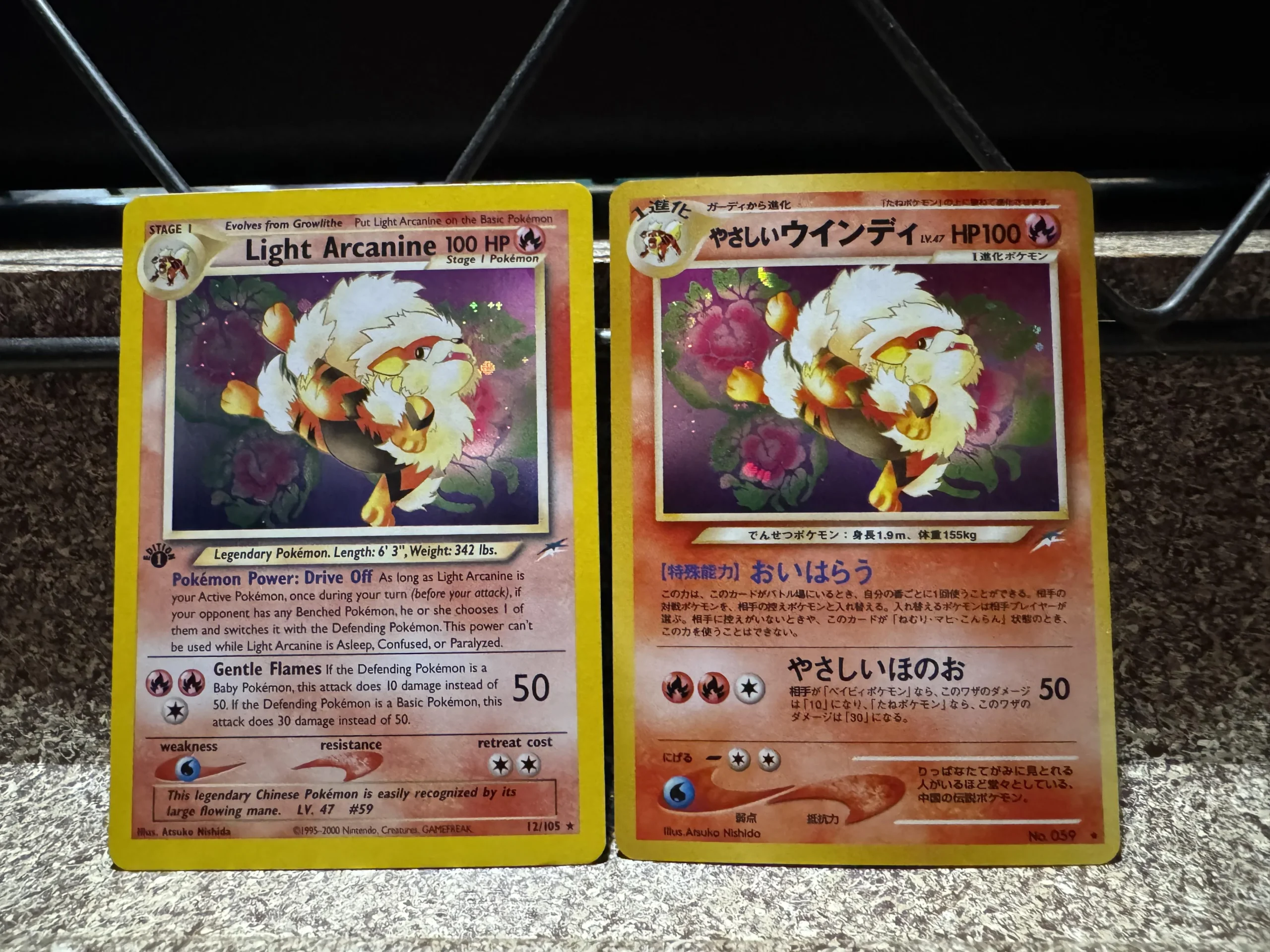
If you collect Pokémon cards, sooner or later you will encounter the same artwork in both Japanese and English—and wonder which version you should buy.
Are Japanese Pokémon cards better quality? Are they rarer? Are English cards worth more? Do Japanese sets contain the same cards? And can you actually play Japanese cards outside Japan?
The short answer is that Japanese and English Pokémon cards belong to closely related but distinct versions of the Pokémon TCG ecosystem.
They can differ in set composition, numbering, rarity, finishes, promotional releases, market value and tournament usability. TCGplayer explicitly notes that Japanese and English Pokémon sets are not a one-to-one match and that even cards using the same artwork can have different set codes, card numbers, rarities and finishes. TCGplayer
If you are new to collecting cards from Japan, start with our complete guide to Japanese Pokémon cards.
Japanese vs English Pokémon Cards at a Glance

| Difference | Japanese Cards | English Cards |
|---|---|---|
| Language | Japanese | English |
| Market | Primarily Japan | International English-speaking markets |
| Set structure | Japanese expansions and products | International sets can reorganize Japanese releases |
| Numbering | Japanese set numbering | International numbering |
| Rarity terminology | AR, SR, SAR, UR etc. | IR, Ultra Rare, SIR, Hyper Rare etc. |
| Promos | Many Japan-specific releases | International/regional promos |
| Printing | Produced through Japanese operation | Produced in US/EU |
| Availability | Best availability in Japan | Much easier globally |
| Tournament use | Restrictions outside Japan | Widely usable in English-speaking regions |
| Value | Depends on card | Depends on card |
The most important point is that neither version is universally better.
The right version depends on whether you care most about collecting, artwork, gameplay, resale, exclusive releases or simply personal preference.
Are Japanese and English Pokémon Cards the Same?
Sometimes they are very similar.
Sometimes they are not.
You can find a Japanese and an English card sharing essentially the same illustration and gameplay mechanics, but that does not necessarily mean they belong to equivalent sets.
TCGplayer specifically warns that Japanese and English Pokémon releases are not direct one-to-one matches. Cards using the same artwork can have different:
set codes, collector numbers, rarities, finishes and editions. Japan also receives promotional and special-edition cards that may never receive a direct English equivalent. TCGplayer
This distinction becomes particularly important when identifying or valuing a card.
Searching:
Charizard Japanese
is often not enough.
The exact set code + collector number + rarity tells you which printing you actually own.
Our Japanese Pokémon Card Rarity Guide explains how to identify these rarity codes and numbers.
Japanese and English Pokémon Sets Are Structured Differently
One common mistake among new collectors is assuming that every Japanese expansion has an English equivalent with exactly the same checklist.
It does not.
The Japanese Pokémon TCG has its own product catalogue, while international releases can reorganize cards differently.
As a result, an international expansion may incorporate cards originating from more than one Japanese product.
Conversely, certain Japanese products, promotional cards or variants may have no direct English counterpart at all. For collectors, that means Japanese sets are worth treating as their own collection rather than simply as foreign-language copies of English sets.
Japanese vs English Pokémon Card Rarity
This is another major difference.
Modern Japanese cards commonly use printed rarity codes such as:
C, U, R, RR, AR, SR, SAR and UR.
English releases use some different terminology.
For example:
| Japanese | Rough English Equivalent |
|---|---|
| AR — Art Rare | Illustration Rare |
| SR — Super Rare | Ultra Rare |
| SAR — Special Art Rare | Special Illustration Rare |
| UR — Ultra Rare | Hyper Rare |
This creates some confusing situations.
A card described as Ultra Rare in Japanese terminology is not necessarily the same rarity category as an English Ultra Rare.
And a Japanese SAR may correspond to what English collectors call an SIR.
That is why the printed code, set and language should always be checked before comparing prices.
→ Internal link here: Japanese Pokémon Card Rarity Guide
Are Japanese Pokémon Cards Better Quality?
You will often read statements like:
Japanese Pokémon cards are always higher quality.
I would not treat that as a universal rule.
What we can establish objectively is that the cards are produced through different manufacturing operations.
Pokémon Support states that The Pokémon Company International prints English, French, Italian, German and Spanish cards in the United States or European Union, while The Pokémon Company in Japan supports Japanese-language cards. Support Pokémon
Collectors can therefore encounter differences in:
card stock, foil treatment, texture, color reproduction, cutting and other physical characteristics.
But those differences depend on the specific set and production run.
A Japanese card can still have centering problems, surface damage or manufacturing imperfections.
Likewise, an English card can be extremely well produced.
So rather than saying:
Japanese = better quality
a more accurate rule is:
Japanese and English cards can have noticeably different production characteristics. Evaluate the actual card and set.
For grading in particular, condition matters more than the reputation of the language printed on the card.
Do Japanese Cards Look Different?
They often can.
Even where the illustration itself is shared, differences may appear in:
foil patterns, borders, textures, rarity indicators, card numbers, set symbols and copyright information.
Some Japanese releases also feature finishes or parallel cards that have no direct international equivalent.
TCGplayer specifically mentions Japanese-exclusive promotional releases and special finishes, including certain Mirror Holofoil variants. TCGplayer
This is part of the appeal for collectors.
You are not necessarily buying the same object with different text printed on it.
Sometimes the physical card itself is a different collectible.
Japanese Pokémon Cards and Exclusive Promos
This is where collecting Japanese cards becomes significantly more interesting.
Japan receives promotional Pokémon cards through channels such as:
Pokémon Centers, retail campaigns, tournaments, Pokémon Card Gym events, collaborations and special product releases.
Some later receive similar international releases.
Others do not.
Certain Japanese cards, products and promotional items have no English counterpart. For Japan-focused collectors, this distinction is important.
There is a big difference between:
Japanese-language version of a globally available card
and
a genuinely Japan-exclusive Pokémon card.
The second category is where the Japanese market can offer something that an English collection simply cannot reproduce.
We will cover these separately in our upcoming Japan-Exclusive Pokémon Cards & Promos guide.
Are Japanese Pokémon Cards Worth More Than English Cards?
Sometimes.
But absolutely not always.
This is probably the biggest misconception surrounding Japanese Pokémon cards.
Language alone does not determine value.
For a particular card, the Japanese version may be:
more expensive, cheaper or approximately equal in value to the English version.
Several forces influence the difference.
Collector demand
English-language Pokémon collecting has an enormous international audience.
That alone can create stronger demand for certain English cards.
Supply
A Japanese card may have been printed or distributed differently from its international counterpart.
Exclusive artwork or printing
A card that is genuinely exclusive to Japan has a very different value proposition from simply being the Japanese version of an internationally common card.
Pokémon popularity
Charizard, Pikachu, Eeveelutions and other heavily collected Pokémon can behave very differently from less popular characters.
Condition and grading
A pristine card can command a substantial premium regardless of language.
Historical importance
Some Japanese cards have unique historical significance because Japan is the original Pokémon TCG market.
The important rule is:
Compare exact printings, not just Pokémon names.
For example, comparing a Japanese SAR directly with a completely different English rarity printing tells you little about whether Japanese cards are “more valuable.”
Our Japanese Pokémon Cards Value Guide will go much deeper into this.
Why Are Some Japanese Pokémon Cards Cheaper?
A cheaper Japanese version does not necessarily mean it is worse or less rare in an absolute sense.
The answer can simply be market supply and demand.
If a card is widely available in Japan but heavily demanded by English-speaking collectors in its English version, the English card may command a premium.
Availability also matters.
A collector in the US or UK may be willing to pay more for an English card that is immediately available through domestic marketplaces.
Japanese cards sometimes require importing, proxy buying or dealing with Japanese sellers.
Conversely, genuinely Japan-exclusive cards can behave very differently.
This is why general rules like:
Japanese cards are cheaper
or
Japanese cards are more expensive
are both unreliable.
You need to compare the exact card.
Japanese vs English Booster Packs and Boxes
Sealed products also differ.
Do not assume that a Japanese booster box contains the same number of packs, cards per pack or product structure as the corresponding English release.
Japanese Pokémon products operate within their own catalogue, and special categories such as High Class Packs can have configurations different from normal international boosters.
This affects both collecting and price comparisons.
If someone offers:
Japanese booster box for $X
the relevant questions are not simply whether the price is lower than an English box.
You need to know:
the exact set, original Japanese product configuration and what that release was designed to contain.
We will cover this in Japanese Pokémon Booster Boxes Explained and Best Japanese Pokémon Booster Boxes to Buy.
Are Japanese Pokémon Cards Better for Collectors?
They can be—depending on what you collect.
Japanese cards are particularly attractive if you care about:
- Japanese-exclusive promos
- Artwork
- Original releases
- Japanese set collecting
- Pokémon Center products
- the history of the Pokémon TCG in Japan.
English cards may make more sense if your priorities are:
- easy availability
- English-language gameplay
- easier domestic resale or completing international sets.
A collector interested primarily in artwork might happily own Japanese AR and SAR cards.
Someone building competitive decks in North America or Europe may strongly prefer English copies.
Neither approach is inherently better.
Can You Play Japanese Pokémon Cards in English Decks?
For casual play, that depends on the people and venue you are playing with.
Official competition is different.
Play! Pokémon applies card-language rules to organized tournament environments. TCGplayer’s current Japanese Pokémon FAQ states that Japanese cards are not legal for Play! Pokémon Championship Series events under the tournament rules. TCGplayer
Pokémon also updated its competitive rules again in September 2026 and recommends players check the latest tournament documentation before participating. Pokemon
This means a Japanese card can be perfectly authentic and have a currently legal regulation mark while still being unusable at a particular Championship Series event because of language restrictions.
Collectors who also play competitively should therefore check current local rules before purchasing Japanese versions for their decks.
Are Japanese Pokémon Cards More Difficult to Collect?
Not necessarily, but the process is different.
International collectors can increasingly purchase Japanese cards through specialist TCG stores and international marketplaces.
Going deeper into the hobby may involve buying directly from Japan.
That opens access to:
Japanese card shops, domestic marketplaces, second-hand stores and releases that never reached international retailers.
The trade-off is increased complexity involving shipping, proxy services, customs and seller evaluation.
We cover this separately in How to Buy Pokémon Cards From Japan.
Which Should You Collect: Japanese or English Pokémon Cards?
There is no single right answer.
For many collectors, the best solution is actually both.
You might collect English cards for childhood nostalgia or set completion while buying Japanese versions when:
the artwork looks better to you, a Japanese promo is exclusive, a Japanese copy is significantly cheaper or you simply prefer the appearance of Japanese cards.
If you are primarily interested in Japanese Pokémon culture and collecting, the Japanese market obviously offers much more depth.
What I would avoid is choosing purely on the assumption that one language is always:
more valuable, rarer, better printed or a better investment.
Those statements collapse thousands of different cards and production runs into one rule that does not exist.
Choose the specific printing, not simply the language.
Japanese vs English Pokémon Cards FAQ
Are Japanese Pokémon cards better than English cards?
Not universally. Production, finishes and set structures can differ, but quality should be judged by the specific card and release rather than language alone.
Are Japanese Pokémon cards rarer?
Some are. Others are widely available. Genuine Japan-exclusive promos can be scarce, while ordinary Japanese versions of internationally available cards may not be.
Are Japanese Pokémon cards cheaper?
Sometimes. Prices depend on supply, demand, character popularity, rarity and the exact printing.
Are Japanese Pokémon cards worth more?
Not automatically. Some Japanese cards command a premium, while the English version of other cards can be considerably more valuable.
Do Japanese Pokémon cards have different rarity symbols?
Yes. Modern Japanese cards commonly use codes such as AR, SR, SAR and UR, while comparable English rarity names can differ.
Do Japanese and English Pokémon sets have the same cards?
Not necessarily. Japanese and English sets are not direct one-to-one equivalents and can differ in composition, numbering, rarities, finishes and promos. TCGplayer
Are Japanese Pokémon cards printed in Japan?
Pokémon states that Japanese-language cards are supported by The Pokémon Company in Japan, while several international languages including English are printed in the US or EU. Support Pokémon
Can I use Japanese cards in Pokémon tournaments?
Language restrictions apply to organized competitive events, so do not assume an otherwise Standard-legal Japanese card can be used at a Championship Series event outside Japan. Check the latest Play! Pokémon rules for your event. Pokemon
Japanese or English? Collect the Card You Actually Want
The biggest difference between Japanese and English Pokémon cards is not simply the language.
They operate within different product ecosystems.
Sets can be structured differently. Rarity terminology differs. Promotional cards can be exclusive. Physical finishes may vary. Prices can move independently, and competitive rules can make one version much more practical than another.
For collectors, that is precisely what makes Japanese cards interesting.
Rather than asking:
Are Japanese Pokémon cards better?
a more useful question is:
Which version of this specific card fits my collection better?
Once you start comparing the exact set, artwork, rarity, printing and price, the answer becomes much easier.