Magic: The Gathering has always brought together fantasy worlds, distinctive visual styles, and artists from different creative backgrounds. But among its countless cards, there is a small and particularly fascinating group that deserves special attention from collectors: Japanese Exclusive Planeswalkers featuring Japanese-inspired artwork, illustrations by Japanese artists, or editions originally created specifically for the Japanese market.
From the manga-inspired Jace and Chandra released in 2010 to the extraordinary Japanese alternate-art collection from War of the Spark in 2019, these cards represent a unique meeting point between Western fantasy illustration and Japanese visual culture.
They are not all exclusive to Japan in the strictest sense. Some were initially released through Japanese products, while others were printed only in Japanese despite being distributed internationally. What connects them is their distinctive artistic identity and the important role played by Japanese illustrators.
Here is a look at the Planeswalker cards that every Magic collector interested in Japanese art should know.
Jace Beleren and Chandra Nalaar: The Japanese Duel Deck (2010)
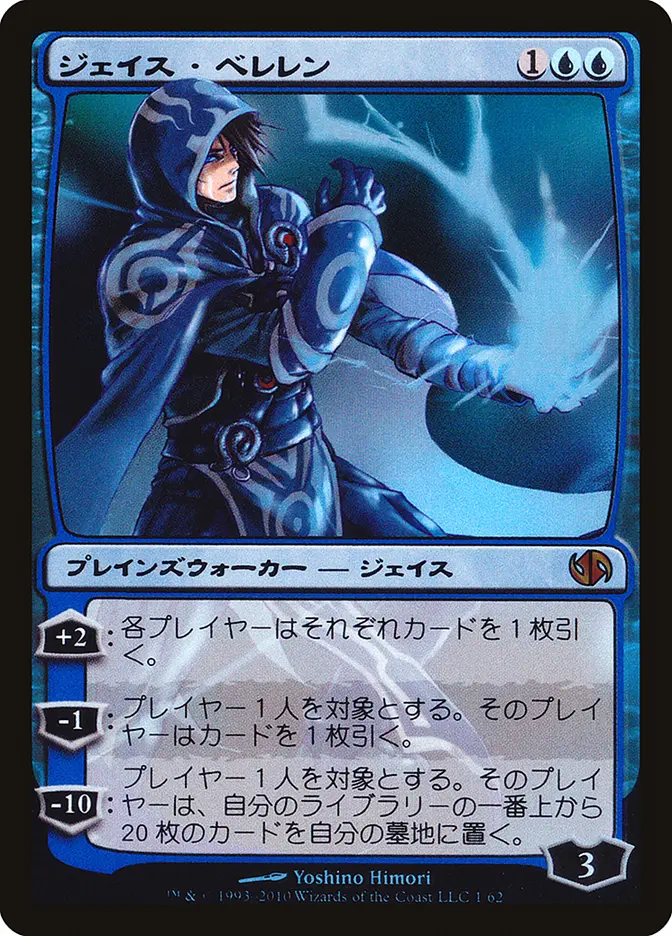
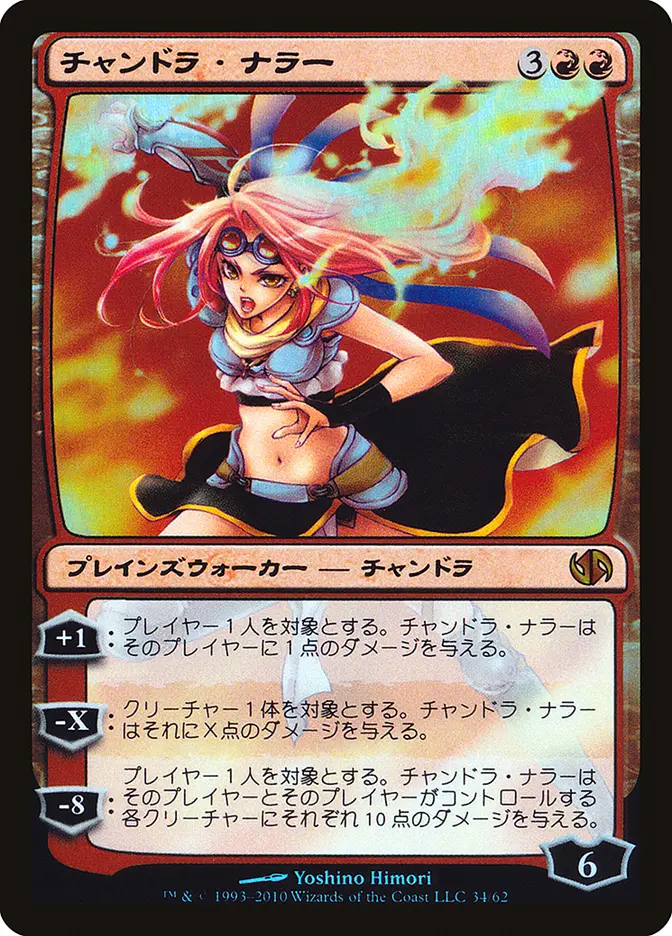
One of the earliest and most interesting exampl.es of Japanese-exclusive Planeswalker artwork appeared in December 2010, when Wizards of the Coast released a Japanese-language edition of Duel Decks: Jace vs. Chandra.
The original Duel Deck had been released in English in November 2008. However, the Japanese edition introduced something special: entirely new, manga-inspired illustrations for its two central characters, Jace Beleren and Chandra Nalaar.
Both cards were illustrated by Yoshino Himori, a Japanese manga artist whose work gave the two iconic Planeswalkers a completely different visual identity.
Jace received a more expressive, anime-inspired appearance, while Chandra’s illustration emphasized her fiery personality through a distinctly Japanese illustration style. Both cards were also released as premium foil versions, making them particularly attractive to collectors.
Unlike the original English Duel Deck artwork, these two illustrations were created specifically for the Japanese release. They remain among the most recognizable examples of Magic’s early collaboration with Japanese manga artists.
For collectors, the appeal goes beyond the characters themselves. These cards represent a specific moment in Magic’s history, when Wizards experimented with a more direct connection between the Japanese manga aesthetic and its fantasy universe.
War of the Spark: The 36 Japanese Alternate-Art Planeswalkers (2019)
If the 2010 Jace and Chandra cards were an early experiment, 2019 was the moment when Japanese alternate artwork became a major collecting phenomenon.
To celebrate the release of War of the Spark, Wizards of the Coast commissioned Japanese artists to create alternative illustrations for all 36 Planeswalkers featured in the expansion.
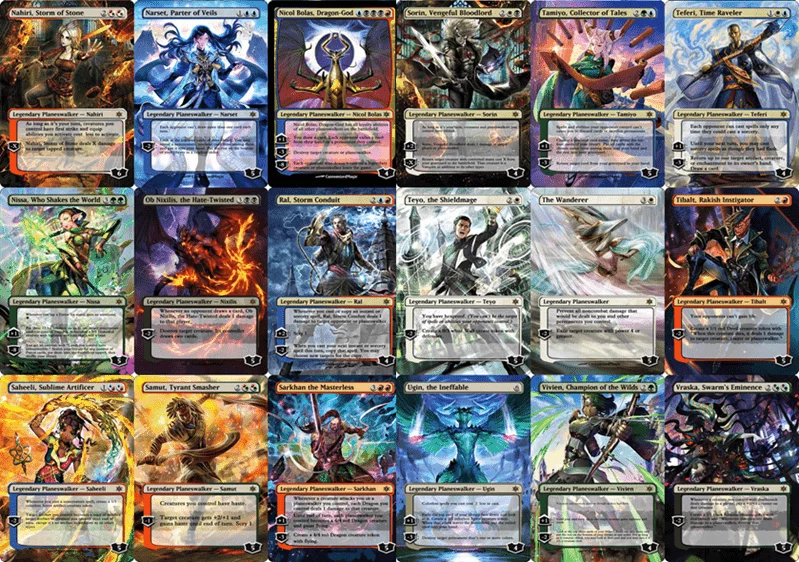
The result was an extraordinary collection of 36 cards, each featuring a completely different interpretation of its character.
The project involved 28 Japanese artists, including some particularly well-known names from the worlds of manga, anime, video games, and fantasy illustration.
What made this release special was not simply the alternative artwork. Wizards also decided that these versions would be printed exclusively in Japanese, giving them a distinctive identity compared with their regular counterparts.
How could collectors obtain them?
The Japanese alternate-art Planeswalkers could be found randomly in Japanese-language War of the Spark booster packs.
According to Wizards of the Coast, an alternate-art Planeswalker replaced the regular version in approximately 50% of booster packs containing a Planeswalker.
They were also made available through Wizards Play Network promotional packs during the Core Set 2020 season. This meant that, although the cards were printed only in Japanese, collectors outside Japan could also obtain them through official distribution channels.
The 36 Japanese alternate-art Planeswalkers
The collection includes every Planeswalker represented in War of the Spark:
- Ajani, the Greathearted
- Angrath, Captain of Chaos
- Arlinn, Voice of the Pack
- Ashiok, Dream Render
- Chandra, Fire Artisan
- Davriel, Rogue Shadowmage
- Domri, Anarch of Bolas
- Dovin, Hand of Control
- Gideon Blackblade
- Huatli, the Sun’s Heart
- Jace, Wielder of Mysteries
- Jaya, Venerated Firemage
- Jiang Yanggu, Wildcrafter
- Karn, the Great Creator
- Kasmina, Enigmatic Mentor
- Kaya, Bane of the Dead
- Kiora, Behemoth Beckoner
- Liliana, Dreadhorde General
- Nahiri, Storm of Stone
- Narset, Parter of Veils
- Nicol Bolas, Dragon-God
- Nissa, Who Shakes the World
- Ob Nixilis, the Hate-Twisted
- Ral, Storm Conduit
- Saheeli, Sublime Artificer
- Samut, Tyrant Smasher
- Sarkhan the Masterless
- Sorin, Vengeful Bloodlord
- Tamiyo, Collector of Tales
- Teferi, Time Raveler
- Teyo, the Shieldmage
- Tibalt, Rakish Instigator
- The Wanderer
- Ugin, the Ineffable
- Vivien, Champion of the Wilds
- Vraska, Swarm’s Eminence
This makes the collection particularly appealing: rather than featuring just a handful of selected characters, the project gave the entire Planeswalker cast of the expansion a Japanese artistic reinterpretation.
Japan-Exclusive Planeswalker Promos: The PWCS, PWFM and PWS Collections
Beyond special editions and alternate-art booster cards, Japan has another fascinating category of Magic: The Gathering collectibles: promotional Planeswalkers distributed through Japan-exclusive organized play events.
These cards are particularly interesting because they were created for local Japanese tournament programs and are associated with promotional releases that collectors outside Japan could not obtain through ordinary booster packs.
The story began in 2019 with the Planeswalker Championship (PWCS), a Japan-only tournament program held at authorized Wizards Play Network stores. Its promotional cards were distributed according to tournament results, with different rewards for participants, finalists, and winners.
In April 2023, the program evolved into the Planeswalker Friendly Match (PWFM), maintaining its focus on accessible Standard events and exclusive promotional cards. It was subsequently followed by the Planeswalker Series (PWS), which continues the tradition of Japan-only organized play.

The Japanese Planeswalker promo collection
Several iconic Planeswalkers have appeared in these promotional releases:
2019 – PWCS
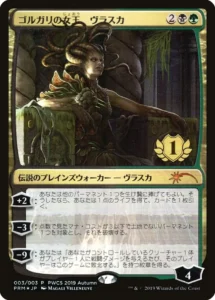
- Vraska, Golgari Queen – Autumn 2019, illustrated by Magali Villeneuve.
2020 – PWCS
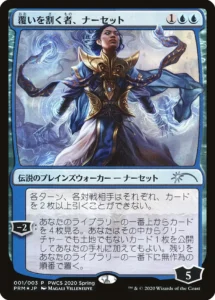
- Narset, Parter of Veils – Spring 2020, illustrated by Magali Villeneuve.
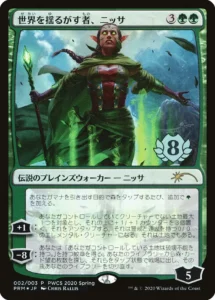
- Nissa, Who Shakes the World – Spring 2020, illustrated by Chris Rallis.
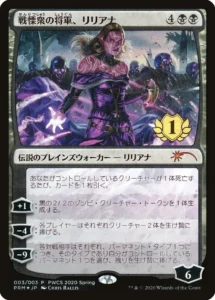
- Liliana, Dreadhorde General – Spring 2020, illustrated by Chris Rallis.
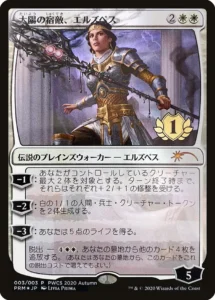
- Elspeth, Sun’s Nemesis – Autumn 2020, illustrated by Livia Prima.
2021 – PWCS
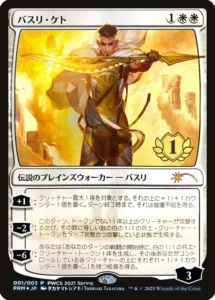
- Basri Ket – Spring 2021, illustrated by Toshiaki Takayama.
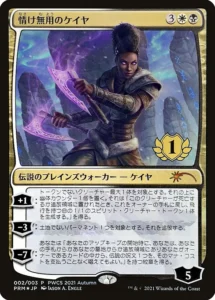
- Kaya the Inexorable – Autumn 2021, illustrated by Jason A. Engle.
2022–2023 – PWCS
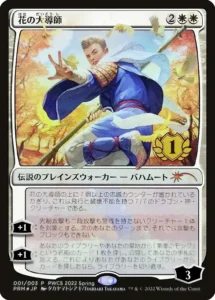
- Grand Master of Flowers – Spring 2022, illustrated by Toshiaki Takayama.
- The Wandering Emperor – Autumn 2023 promotional release, illustrated by Takayuki Futami.
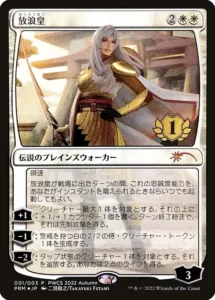
2023 – PWFM
- Elspeth Resplendent – Spring 2023, illustrated by Areku Nishiki.
- Liliana of the Veil – Autumn 2023, illustrated by Yuichi Murakami.
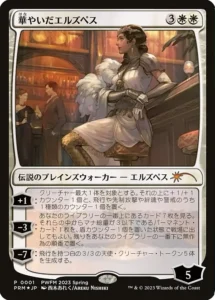
2024 – PWFM
- Kaya, Spirits’ Justice – Autumn 2024, illustrated by Areku Nishiki.
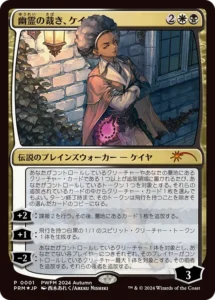
2025 – PWFM
- Jace Reawakened – Winter 2025, illustrated by Hozan Shinomaru.
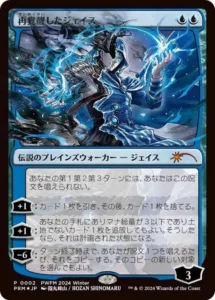
These releases are particularly appealing because several feature full-art or specially cropped artwork, giving familiar characters a different appearance from their regular versions.
Japanese artists and distinctive illustrations
Some of these promotional cards are especially interesting from an artistic perspective.
Basri Ket and Grand Master of Flowers, for example, feature illustrations by Toshiaki Takayama, while Liliana of the Veil received a Japanese promotional version illustrated by Yuichi Murakami.
Another noteworthy example is Jace Reawakened, whose promotional artwork was created by Hozan Shinomaru. Kaya, Spirits’ Justice, illustrated by Areku Nishiki, is another interesting addition to the collection.
It is worth remembering that not every card in this series was illustrated by a Japanese artist. Some illustrations were created by international Magic artists, but the cards themselves belong to a promotional program specifically designed for the Japanese market.
Are PWCS and PWFM Planeswalkers exclusive to Japan?
Yes, their original promotional distribution was tied to Japanese organized-play events, and these versions were produced as Japanese-language promotional cards.
This makes them different from the Japanese alternate-art Planeswalkers found in War of the Spark boosters. The latter were available through Japanese-language booster products, whereas PWCS and PWFM promos were connected to specific local tournament rewards.
The distinction is important for collectors looking for genuine Japan-exclusive Magic releases.
The PWCS, PWFM and PWS collections also extend beyond Planeswalkers: their promotional cards include creatures, instants, and other card types. However, the Planeswalker cards are particularly interesting because they bring together recognizable characters, special promotional treatments, and Japan’s unique organized-play history.
For anyone building a collection of Japanese Magic cards, these releases deserve a place alongside the 2010 Jace vs. Chandra Duel Deck and the 36 alternate-art Planeswalkers from War of the Spark.
Yoshitaka Amano’s Liliana: The Most Recognizable Japanese Alternate Art?
Among the 36 cards, one illustration immediately stands out to collectors familiar with Japanese fantasy and video game art.
Liliana, Dreadhorde General was illustrated by Yoshitaka Amano, the legendary Japanese artist and character designer widely recognized for his work on the Final Fantasy franchise.
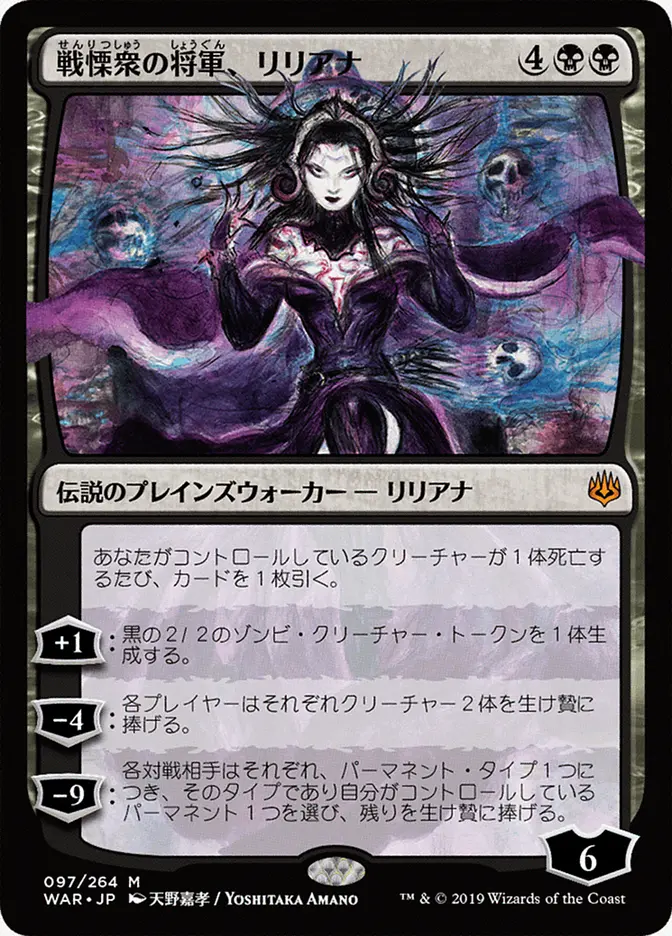
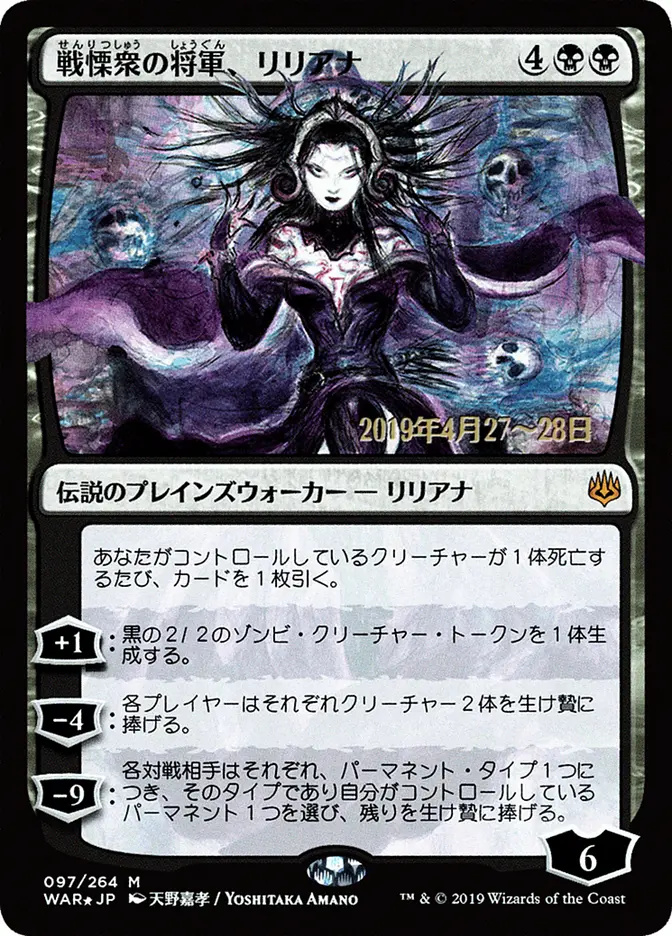
Amano’s unmistakable style, characterized by elegant figures, flowing lines, delicate details, and an almost ethereal atmosphere, gives Liliana an entirely different presence from her original illustration.
His contribution is particularly significant because it connects two major fantasy universes: Magic: The Gathering and Final Fantasy.
For collectors, this card is arguably one of the most recognizable pieces in the entire Japanese alternate-art collection. Its appeal extends beyond Magic players to fans of Amano’s wider artistic career.
RELATED
Japanese Exclusive MTG Cards: All Japan-Only Magic Cards and Alternate Art
For more than two decades, Wizards of the Coast has released Japanese-language cards, Japan-exclusive promos, alternate-art treatments, collaborations with Japanese artists, and cards inspired by Japanese mythology, manga and popular culture.

More Japanese Artists Behind the Cards
Amano may be the most internationally recognizable name, but the project brought together a much wider group of illustrators.
Some of the participating artists have extensive experience in Japanese video games, trading card games, anime-related projects, and fantasy illustration.
A few notable examples include:
- Daisuke Izuka: Known for his illustrations connected to the Fire Emblem series.
- Naochika Morishita: An artist associated with detailed science-fiction and mecha illustrations, including work related to Gundam.
- Raita Kazama: Known for his distinctive character designs and work in Japanese games.
- Fuzichoco: Recognized for colorful fantasy illustrations and character artwork.
- Toshiaki Takayama: An illustrator with experience in Japanese game and character design.
Together, these artists brought a wide range of visual influences to the Magic universe. Some cards have a distinctly manga-inspired appearance, while others lean towards traditional fantasy illustration, detailed character portraits, or more experimental compositions.
This variety is one of the reasons why collecting the complete set can be so rewarding.
Are Japanese Alternate-Art Planeswalkers Really Exclusive to Japan?
There is an important distinction worth making.
The 2010 Jace Beleren and Chandra Nalaar cards were introduced through a Japanese-language reissue of Duel Decks: Jace vs. Chandra. Their alternate illustrations were created specifically for that edition.
The 2019 War of the Spark alternate-art Planeswalkers followed a slightly different distribution model. They were printed only in Japanese, but Japanese-language boosters were distributed internationally, and the promotional versions could also be obtained through Wizards Play Network stores around the world.
Therefore, calling all these cards strictly Japan-exclusive would be inaccurate.
A better description would be Japanese-exclusive artwork and Japanese-language Planeswalker editions.
For collectors, however, this distinction does not make them any less interesting. Their unique illustrations, Japanese-language printing, and connections to prominent Japanese artists make them some of the most distinctive Planeswalker variations in Magic’s history.
Why Collect Japanese Planeswalkers?
Japanese alternate-art Planeswalkers are interesting for several reasons.
First, they offer a different artistic interpretation of characters that Magic players have known for years. Second, they connect the game with Japan’s wider creative industries, including manga, anime, video games, and fantasy illustration.
Finally, they represent specific moments in Magic’s history: the 2010 Jace vs. Chandra Japanese edition and the ambitious 2019 War of the Spark collaboration.
Whether you are a dedicated Magic collector, a fan of Japanese illustration, or simply someone who appreciates unusual trading card artwork, these Planeswalkers are worth discovering.
They are a reminder that Magic’s multiverse is not only shaped by its stories and characters, but also by the different artistic traditions that bring those characters to life.