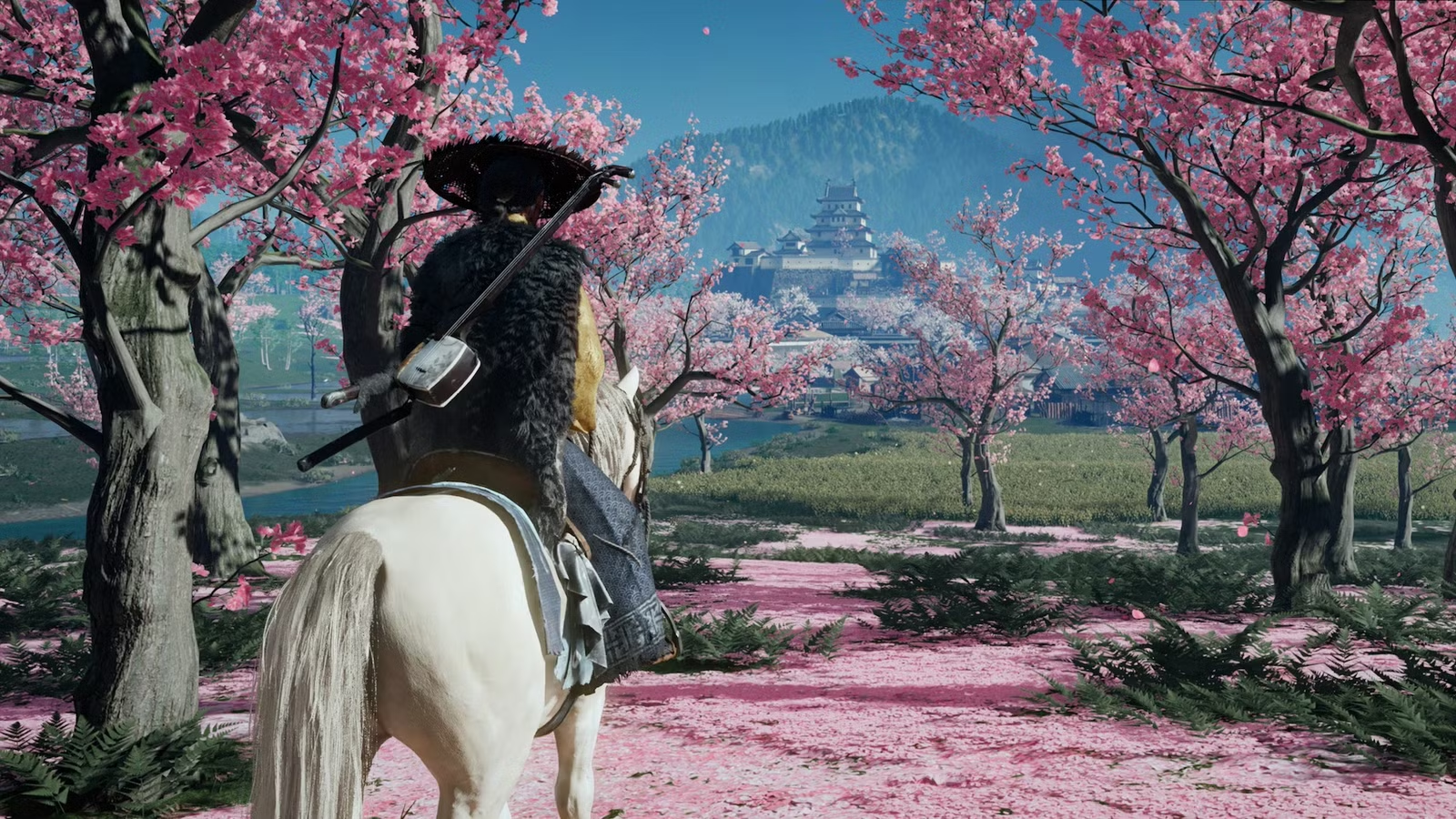
Few video games make the landscape feel as alive as Ghost of Tsushima. A fox disappears into the forest, the wind sweeps across a field of pampas grass, and a solitary shrine stands above the sea, reached only by a narrow path along the cliffs. These moments rarely interrupt the action. Instead, they encourage players to slow down and observe a world in which nature, spirituality, and human conflict are closely intertwined.
Released in 2020, Sucker Punch Productions’ samurai adventure takes place during the Mongol invasion of Tsushima in 1274. Its protagonist, Jin Sakai, must defend his homeland while confronting the traditions that have shaped his identity as a samurai. Although the invasion provides the historical foundation, the game’s atmosphere draws on a much broader range of Japanese cultural influences, from Shinto religious traditions and folklore to classical poetry and the visual language of samurai cinema.
Understanding these connections makes Ghost of Tsushima more than a beautiful historical adventure. It reveals how a modern video game can reinterpret centuries of cultural imagery to explore honor, belonging, sacrifice, and the complicated relationship between people and the world around them.
The Sacred Landscape: Shinto, Kami, and the Spiritual World
One of the most striking characteristics of Ghost of Tsushima is the way it presents nature. Forests, mountains, waterfalls, and ancient trees rarely feel like neutral scenery. They seem to possess a presence of their own, encouraging Jin—and the player—to approach the landscape with curiosity and respect.
This atmosphere has meaningful parallels with Shinto, Japan’s indigenous religious tradition. Shinto encompasses a wide range of beliefs and practices associated with kami, a term that can refer to deities, sacred presences, or extraordinary powers connected with natural phenomena, places, and ancestral traditions. Kami are not simply equivalent to the monsters and supernatural creatures found in Western fantasy; their significance emerges from particular relationships between people, communities, and the sacred.
Shinto does not suggest that every tree or mountain is understood in exactly the same way. Nevertheless, the recognition that certain natural places possess spiritual significance offers a useful perspective on the world Sucker Punch has created.
Across Tsushima, the player encounters shrines hidden among forests, perched on cliffs, or surrounded by dramatic rock formations. Reaching them often requires leaving the main road and following a narrow path through the wilderness. The journey itself becomes part of the experience, transforming exploration into something resembling a small pilgrimage.
These shrines are artistic interpretations rather than precise reconstructions of medieval religious practice. Yet their placement reinforces an important theme: the island is not merely territory to defend. It is a place with its own identity, history, and spiritual significance.
Shinto Shrines and the Meaning of Sacred Places
In Japan, Shinto shrines are places where kami are enshrined and worshipped. Their architecture, ritual practices, and relationship with the surrounding environment vary considerably, but the boundaries between the sacred and everyday life are often expressed through recognizable features such as torii gates, purification practices, and designated sacred grounds.
Ghost of Tsushima uses shrines as moments of separation from the violence of the main story. Jin may spend hours fighting Mongol soldiers before climbing to a remote sanctuary, where the pace slows and the surrounding landscape becomes the main attraction.
This contrast is important. The game’s world contains enormous destruction, but it also contains places that encourage reflection and continuity. Even as war threatens the island’s communities, the shrines remain symbols of traditions that extend beyond the immediate conflict.
The game’s spiritual atmosphere should not be mistaken for a comprehensive representation of Japanese religion. Shinto and Buddhism have interacted throughout Japanese history, and many historical religious practices developed through this relationship. The game simplifies that complex landscape to create a coherent experience, but its emphasis on sacred places remains one of its strongest cultural elements.
WHERE TO BUY
Ghost of Tsushima Director’s Cut
PS5 · Physical Edition

Kitsune, Inari, and the Spiritual Role of Foxes
Among the most memorable encounters in Ghost of Tsushima are the fox dens. When Jin discovers a fox in the wilderness, the animal leads him through the landscape toward an Inari shrine. Rather than attacking or fleeing permanently, the fox acts as a guide, encouraging the player to explore a quieter side of the island.
This mechanic draws on a well-established element of Japanese religious culture. Foxes, known as kitsune, are closely associated with Inari, a kami connected with rice, agriculture, prosperity, and abundance. Foxes are traditionally regarded as messengers or attendants of Inari, which explains why their statues frequently appear at Inari shrines.
The relationship is important because Inari is not itself a fox. The official English-language FAQ of Fushimi Inari Taisha, Kyoto’s famous Inari shrine, explicitly distinguishes the deity from its fox messengers. The shrine’s official FAQ offers a useful introduction to this distinction.
Japanese folklore also gives kitsune a much broader identity. In traditional stories, foxes may deceive humans, transform themselves, test people’s character, or form unexpectedly loyal relationships with them. Some tales portray them as dangerous supernatural beings, while others describe protective or benevolent figures.
The foxes in Ghost of Tsushima emphasize the protective side of this tradition. They guide Jin toward sacred places and reward the player’s attention to the environment. Their role is less about reproducing a specific folktale and more about translating a recognizable cultural association into interactive storytelling.
This is one of the game’s most effective design choices. A conventional open-world adventure might mark a shrine with a symbol on the map. Here, a living animal draws the player toward it, making discovery feel like an encounter rather than a checklist.
The result is a subtle reminder that Japanese folklore does not consist exclusively of terrifying spirits and hostile monsters. Its supernatural beings can also serve as guides, guardians, and intermediaries between the human and spiritual worlds.
The Guiding Wind: Nature as a Companion
The wind is perhaps the most distinctive feature of Ghost of Tsushima‘s exploration system. Instead of relying entirely on a conventional navigation marker, players can summon a gust that points toward their selected destination.
It is an elegant gameplay solution, but its importance extends beyond convenience. Wind moves through tall grass, carries leaves across the screen, and changes the appearance of the landscape. It becomes a constant presence that connects the player to the environment.
The mechanic should not be interpreted as a direct representation of a specific Shinto ritual or doctrine. Its significance lies primarily in its artistic design. Nevertheless, it fits naturally into a world where the landscape is treated as something to experience rather than simply cross.
The wind also establishes a distinctive rhythm. A player might follow it toward a quest objective, become distracted by a bird, discover a hidden path, and eventually arrive at a shrine without following the original route. Exploration becomes a process of observation and curiosity.
This approach reflects one of the game’s most successful ideas: the natural world can guide the player without constantly demanding attention. Instead of competing with the story, the landscape becomes part of the storytelling itself.
It also helps distinguish Ghost of Tsushima from open-world games that prioritize map icons and objective markers. Here, navigation encourages players to look at the world, not merely at the interface.
Haiku, Nature, and the Art of Stillness
Not every meaningful encounter in Ghost of Tsushima involves combat or exploration. At certain locations, Jin can sit and compose a haiku, reflecting on his experiences while contemplating the surrounding landscape.
These moments evoke the Japanese poetic tradition associated with haiku, a concise form that often captures a particular moment through natural imagery, seasonal references, and carefully chosen words. Traditional haiku are commonly associated with a 5-7-5 pattern of Japanese sound units, although the form is more nuanced than the familiar English-language description of seventeen syllables suggests.
An important feature of classical haiku is the kigo, a seasonal word or expression that situates the poem within a particular time of year. A reference to cherry blossoms, for example, can evoke spring while carrying additional cultural associations. The landscape becomes a way to communicate emotion without explaining everything directly.
The poems in Ghost of Tsushima are written in English and designed around the game’s narrative. They should not be treated as faithful examples of classical Japanese poetry. There is also a historical distinction worth noting: the familiar standalone haiku form developed long after the game’s thirteenth-century setting. The activity is better understood as a deliberate artistic interpretation than as a historically exact samurai pastime.
Even so, the underlying idea is effective. Jin’s poems explore themes of loss, duty, uncertainty, and the passage of time. They offer a rare opportunity to understand the protagonist outside the demands of warfare, revealing a man who must process the emotional consequences of his actions.
These sequences also demonstrate how the game uses stillness as a form of storytelling. A quiet view across the water can communicate something that another battle scene cannot. By asking players to stop and observe, the game makes reflection an active part of the experience.
RELATED
Ghost of Yōtei: Japanese Ghost Lore, Ainu Culture, and the Legends of Ezo
Developed by Sucker Punch Productions, Ghost of Yōtei combines historical fiction with Japanese ghost lore, regional history, and carefully researched cultural references.
Samurai Cinema: Akira Kurosawa and the Warrior Ideal
The cultural influences behind Ghost of Tsushima extend beyond religious traditions into Japanese cinema, particularly the samurai films of Akira Kurosawa.
Works such as Seven Samurai (1954) and Yojimbo (1961) helped establish a visual and narrative language that has influenced generations of filmmakers and game developers. Carefully staged confrontations, expressive silhouettes, dramatic weather, and sudden bursts of violence all contribute to a style in which combat becomes a form of visual storytelling.
Sucker Punch has openly discussed its admiration for Japanese period films and the influence of directors such as Kurosawa. The game’s black-and-white Kurosawa-inspired mode makes this connection particularly explicit, transforming the presentation into a homage to classic samurai cinema.
The influence goes beyond appearance. Kurosawa’s films often explore the conflict between personal morality, social expectations, and the practical demands of survival. Warriors are not always idealized heroes, and the codes that govern their behavior can become sources of tension rather than straightforward moral guidance.
Jin’s story follows a similar path. He has been trained to confront his enemies openly, to value discipline, and to understand himself through the expectations of his samurai upbringing. The Mongol invasion forces him to reconsider those principles when conventional methods prove insufficient to protect the people of Tsushima.
The resulting conflict is not simply a choice between honor and dishonor. It is a question of what honor means when following established rules produces disastrous consequences.
Bushidō: History Versus the Samurai Myth
The game’s portrayal of samurai honor also deserves a historical qualification. The concept of bushidō, commonly translated as the way of the warrior, is often presented in modern popular culture as a single, timeless code governing all samurai behavior.
Historical reality was considerably more complicated. Samurai values and practices changed over time, and the familiar image of a unified warrior code was shaped by later interpretations as well as by modern literature, cinema, and political ideas.
In the Kamakura period, when Ghost of Tsushima takes place, warrior society operated within its own political and social structures. Loyalty, status, family obligations, landholding, military service, and practical considerations all influenced how warriors behaved. The idea that every samurai followed an identical code of honorable combat is too simplistic.
This distinction makes Jin’s journey more interesting. The conflict between his upbringing and the methods he adopts is not a documentary account of medieval samurai ethics. It is a dramatic interpretation of the tension between tradition and survival, shaped partly by the modern cultural image of the samurai.
The game uses that image to ask a question that remains relevant beyond its historical setting: when the rules of a society fail to protect the people who depend on them, should those rules remain unquestioned?
The Ghost of Tsushima: A Human Legend, Not a Supernatural Spirit
Despite its title and the supernatural associations of Japanese folklore, Ghost of Tsushima does not revolve around literal ghosts. Jin Sakai is a human warrior whose transformation takes place through reputation, fear, and the methods he uses to resist the invasion.
As Jin abandons the conventions of direct samurai combat, he begins to strike from the shadows, employ deception, and use tactics that his upbringing would once have rejected. His enemies increasingly perceive him as something difficult to understand or predict. The Ghost becomes a legend that grows beyond the individual behind it.
This idea has interesting parallels with Japanese ghost stories, although the distinction matters. Japanese folklore includes yūrei, a broad term for ghosts of the dead, and onryō, spirits associated with resentment and vengeance. These traditions often explore unresolved suffering, injustice, and the persistence of the past.
Jin, however, is not an onryō, nor does he become a supernatural being. His power comes from the way stories about him influence the behavior of other people. The legend of the Ghost becomes a psychological weapon, allowing him to challenge an enemy that initially appears far stronger than himself.
The transformation also has a political dimension. Jin’s actions threaten the authority of the samurai leadership because they challenge the established relationship between social status, military duty, and acceptable behavior. The Ghost is effective precisely because he represents something outside the system that produced him.
In this respect, the game uses the language of haunting to explore the creation of a cultural legend. A person becomes a symbol, and the symbol acquires a life of its own.
The most compelling aspect of Jin’s transformation is that it comes at a cost. Becoming the Ghost helps him defend his homeland, but it also places him in conflict with the very traditions that once defined him. His story is ultimately about the price of becoming something that others fear but may desperately need.
How Historically Accurate Is Ghost of Tsushima?
The Mongol invasion of Tsushima in 1274 is a real historical event. The Mongol-led forces of Kublai Khan invaded Japan through the islands of Tsushima and Iki before the campaign reached Kyushu. The invasion, followed by the much larger attempted invasion of 1281, became a significant episode in Japanese history.
Jin Sakai and the central narrative of Ghost of Tsushima, however, are fictional. The game compresses and reimagines historical circumstances to create a personal story of resistance, sacrifice, and cultural conflict. Its representation of combat, characters, and social expectations reflects both historical research and the conventions of modern samurai fiction.
The same distinction applies to the game’s religious and folkloric elements. The association between foxes and Inari is grounded in Japanese religious tradition, while the precise behavior of the foxes and their role in guiding Jin are creative interpretations. The shrines and haiku activities similarly evoke Japanese culture without reproducing every aspect of medieval religious practice or literary history.
This is not a weakness in itself. Historical fiction can introduce audiences to real places and traditions while adapting them to a compelling narrative. The important point is to distinguish the historical foundations from the artistic decisions built upon them.
For players interested in learning more, the game offers an excellent starting point for exploring the history of the Mongol invasions, the development of samurai culture, Shinto traditions, and the influence of Japanese cinema. Its greatest educational value lies not in providing a complete historical account, but in encouraging curiosity about the world that inspired it.
RELATED
Ghost of Tsushima vs Ghost of Yotei
At first glance, Ghost of Tsushima and Ghost of Yōtei share a familiar formula: a lone warrior, a beautiful but dangerous landscape, and a journey shaped by violence, revenge, and personal loss. Yet the meaning of the word ghost changes between the two games.

Why Japanese Folklore Matters to Ghost of Tsushima
The cultural depth of Ghost of Tsushima comes from the way its influences work together. Shinto shrines give the landscape a spiritual dimension, foxes turn exploration into an encounter with folklore, and haiku create moments of reflection that contrast with the violence of war. Samurai cinema provides the visual language, while the story of Jin Sakai explores the tension between personal conviction and social expectations.
None of these elements alone explains the game’s appeal. Their combined effect creates a world in which the environment feels inseparable from the characters who inhabit it.
The island is not simply a backdrop for Jin’s transformation. Its shrines, forests, coastlines, and changing seasons give that transformation a sense of place. As the invasion threatens the communities of Tsushima, the landscape represents something larger than territory: a connection to memory, tradition, and home.
The Ghost himself embodies the same tension. He becomes a legend by abandoning the identity he was taught to uphold, yet his actions are driven by a desire to protect the people and place that shaped him. The result is a story in which cultural identity is neither fixed nor easily discarded.
Ultimately, Ghost of Tsushima succeeds because it treats Japanese culture as more than a collection of recognizable symbols. Its foxes, shrines, poetry, and samurai imagery contribute to a coherent artistic vision, even where historical accuracy gives way to creative interpretation.
The game invites players to look beyond the sword fights and ask what makes a place worth defending, what traditions mean when circumstances change, and how a human being becomes a legend. Its most memorable moments often arrive when the fighting stops and the landscape speaks for itself.
Read also // 10 Best Video Games Set in Japan — From Samurai Legends to Neon Tokyo