Feudal Japan is one of the most fascinating settings in video games.
Centuries of warfare, powerful samurai clans, shinobi, castles, shifting alliances and the rise and fall of the shogunate have given developers an enormous amount of history to work with. Some games aim for a relatively grounded recreation of real events, while others use the period as the foundation for supernatural stories filled with yokai and mythological creatures.
If you’ve already explored our best video games set in Japan, this list goes deeper into the country’s historical settings, from the Mongol invasion of Tsushima to the Sengoku wars and the final years of the Tokugawa shogunate.
Here are some of the best games to play if you want to experience feudal Japan through video games.
Quick List: Best Games Set in Feudal Japan
| Game | Setting | Best for |
|---|---|---|
| Ghost of Tsushima | 1274, Tsushima | Open-world samurai adventure |
| Assassin’s Creed Shadows | Sengoku Japan | Open-world samurai & shinobi |
| Sekiro: Shadows Die Twice | Late Sengoku-inspired Japan | Challenging action |
| Nioh 2 | Sengoku period | Samurai + yokai |
| Nioh 3 | Multiple historical eras | Modern samurai action RPG |
| Total War: Shogun 2 | Feudal Japan | Strategy |
| Shadow Tactics: Blades of the Shogun | Edo period | Tactical stealth |
| Trek to Yomi | Feudal Japan | Cinematic samurai adventure |
| Samurai Warriors 5 | Sengoku period | Large-scale battles |
| Rise of the Ronin | Bakumatsu, 1863 | End of the shogunate |
1. Ghost of Tsushima
Ghost of Tsushima is still one of the easiest recommendations for anyone who wants to explore a large, atmospheric version of historical Japan.
The game takes place during the Mongol invasion of Tsushima in 1274, with Jin Sakai fighting to protect the island after the samurai forces are overwhelmed. Sucker Punch built the story around the real invasion while creating a fictional protagonist and dramatized version of the island.
Its greatest strength is the feeling of travelling through the landscape itself: shrines, villages, bamboo forests, castles and windswept fields make the setting as important as the combat.
Why play it: The best overall choice if you want an accessible open-world samurai game.
Historical focus: Mongol invasion of Japan, samurai warfare, Kamakura-period setting.
2. Assassin’s Creed Shadows
Assassin’s Creed Shadows finally brings Ubisoft’s open-world series to Sengoku-era Japan.
Players alternate between Naoe, a shinobi from Iga, and Yasuke, a samurai, allowing the game to approach the period from two very different styles of play. Ubisoft describes its world as an open recreation of late Sengoku Japan, filled with castle towns, ports, shrines and rural settlements.
For this list, its biggest appeal is scale. Few modern games allow you to roam such a large representation of Japan during one of its most turbulent historical periods.
Why play it: For a large modern open world combining shinobi stealth and samurai combat.
Historical focus: Late Sengoku period, samurai, shinobi and political upheaval.
3. Sekiro: Shadows Die Twice
Sekiro: Shadows Die Twice takes place in a fictionalized Japan inspired by the late 1500s Sengoku period.
FromSoftware doesn’t attempt a strict historical simulation. Instead, castles, warriors and shinobi sit alongside monsters and supernatural elements.
The official game description places the adventure in late-1500s Japan during the violent Sengoku era.
The result is one of the strongest examples of a game using feudal Japan as a historical foundation without being constrained by realism.
Why play it: Exceptional sword combat and a darker interpretation of Sengoku Japan.
Historical focus: Sengoku-inspired warfare, shinobi and samurai culture.
4. Nioh 2

If Sekiro blends history with fantasy, Nioh 2 pushes much further into Japanese folklore.
Its Sengoku-period setting includes historical figures and wars, but the world is filled with yokai, spirits and Onmyo magic.
That makes it particularly useful as a bridge between this article and our guide to the best video games based on Japanese mythology and folklore.
Why play it: For deep action-RPG systems combined with Sengoku history and supernatural Japan.
Historical focus: Sengoku period, samurai, yokai and historical figures.
5. Nioh 3
Because we’re publishing this in 2026, I would definitely include Nioh 3.
Released in February 2026, the newest entry expands the series beyond one period of Japanese history. Its story moves through several eras, including the Warring States period, Edo, Heian Kyoto and the Bakumatsu era.
That makes it slightly different from the other games here: it isn’t exclusively a “feudal Japan game”, but a journey across multiple periods of Japanese history.
Its Sengoku sections, samurai combat and yokai-heavy world nevertheless make it highly relevant to anyone looking for this type of experience.
Why play it: The most recent major samurai action RPG and one of the broadest journeys through historical Japan.
Historical focus: Sengoku, Edo, Heian and Bakumatsu Japan.
6. Total War: Shogun 2
Most games on this list put you behind one sword.
Total War: Shogun 2 instead lets you control entire clans.
The strategy game revolves around unifying Japan, managing territory and diplomacy and commanding large armies of samurai in real-time battles.
SEGA describes the complete edition as covering Japanese history from 1175 to 1876 across its campaigns, including the rise and eventual fall of the samurai era.
It’s therefore one of the strongest choices if you’re more interested in the politics and warfare of feudal Japan than in controlling an individual warrior.
Why play it: The best strategy option on the list.
Historical focus: Daimyo, clan warfare, samurai armies and the shogunate.
7. Shadow Tactics: Blades of the Shogun
Shadow Tactics: Blades of the Shogun approaches historical Japan from a completely different angle.
Set around 1615, in the early Edo period, it follows a five-person team carrying out assassinations, sabotage and espionage for the new shogun.
Instead of direct action, each mission becomes a tactical puzzle.
Your group includes a ninja, samurai, sniper and specialists in deception and traps, and success depends on combining their abilities.
Why play it: Ideal if you want ninjas and samurai without another third-person action game.
Historical focus: Early Edo Japan, shogunate power, ninja and samurai.
8. Trek to Yomi

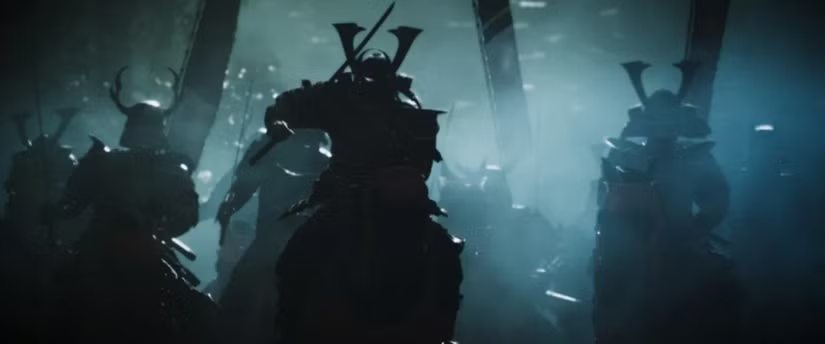
Trek to Yomi is one of the most visually distinctive games on this list.
Its black-and-white presentation deliberately evokes classic Japanese samurai cinema, while the story follows swordsman Hiroki on a journey involving duty, death and supernatural forces.
Devolver describes its world and soundtrack as being designed to evoke feudal Japan, with traditional samurai weaponry and a cinematic presentation inspired by classic Japanese film.
It’s much smaller than Ghost of Tsushima or Assassin’s Creed Shadows, but that’s part of its appeal.
Why play it: For a short, highly stylized samurai experience.
Historical focus: Samurai culture, feudal Japan and supernatural storytelling.
9. Samurai Warriors 5
If you want battles rather than exploration, Samurai Warriors 5 is one of the most direct ways to jump into the Sengoku period.
The story focuses heavily on Nobunaga Oda and Mitsuhide Akechi, covering major conflicts during the Warring States era and the road toward the Honnō-ji Incident.
This is Musou rather than historical simulation: hundreds of enemies can fill a battlefield at once, and historical characters are heavily dramatized.
Still, it offers an accessible route into many of the names and events associated with Sengoku Japan.
Why play it: For huge battles and famous Sengoku-period figures.
Historical focus: Nobunaga Oda, Mitsuhide Akechi and the Sengoku wars.
10. Rise of the Ronin
Rise of the Ronin sits at the very end of Japan’s feudal order.
The game begins in 1863, during the Bakumatsu period, as the Tokugawa shogunate faces internal instability and increasing Western influence.
That makes it quite different from Ghost of Tsushima or Assassin’s Creed Shadows. Firearms, Western clothing and modern ideas increasingly coexist with samurai traditions.
But that’s exactly why it belongs here: it lets you experience the final years of the political system that defined much of Japan’s feudal history.
Why play it: For an open-world look at the collapse of the shogunate.
Historical focus: Bakumatsu, ronin, Tokugawa shogunate and the arrival of Western influence.
What Period Was Feudal Japan?
“Feudal Japan” is a convenient umbrella term rather than one single historical period.
The games on this list span several very different eras:
Kamakura period
→ Ghost of Tsushima
Sengoku / Warring States period
→ Assassin’s Creed Shadows
→ Sekiro
→ Nioh 2
→ Samurai Warriors 5
Early Edo period
→ Shadow Tactics
Late Edo / Bakumatsu
→ Rise of the Ronin
This is useful context because a game set in 1274 Japan can look and feel very different from one set in 1863.
Which Feudal Japan Game Should You Play First?
For a large open-world experience, start with Ghost of Tsushima or Assassin’s Creed Shadows.
If combat difficulty matters more than exploration, choose Sekiro or Nioh 2.
For strategy, Total War: Shogun 2 remains the obvious choice.
For stealth and tactics, try Shadow Tactics.
And if you want the most recent major samurai RPG, Nioh 3 gives you a modern entry point into several different eras of Japanese history.
What About Ghost of Yōtei?
Io aggiungerei questo piccolo box proprio perché è un dettaglio editoriale interessante.
Ghost of Yōtei is set in 1603, but technically its setting complicates a simple “feudal Japan” label.
Sucker Punch places the story around Mount Yōtei in Ezo, present-day Hokkaido, and explicitly notes that this area was outside Japanese rule in 1603.
So while its time period and samurai-adjacent setting make it highly relevant to fans of these games, I wouldn’t describe it simply as “a game set in feudal Japan” without that historical qualification.
More Games Set in Japan
Want to explore beyond historical Japan?
Continue with our guide to the Best Video Games Set in Japan, covering everything from samurai worlds to modern Tokyo.
And if you’re more interested in yokai, gods and traditional legends, see our guide to the Best Video Games Based on Japanese Mythology and Folklore.