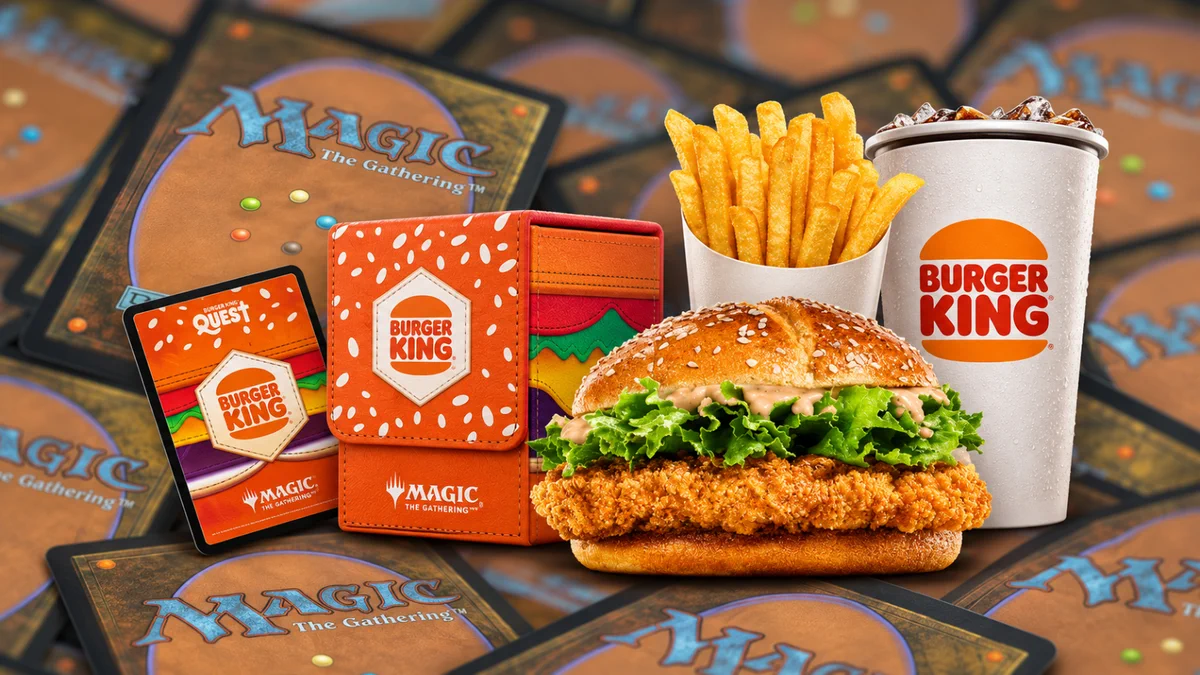
The Burger King x Magic: The Gathering collaboration was supposed to be a fun and unusual crossover between fast food and one of the world’s most popular trading card games. Instead, within hours of its launch in Italy, it became a viral collecting phenomenon, with promotional accessories originally available for €19.90 appearing on resale platforms for prices approaching €200.
The story quickly spread beyond Italy, attracting international attention and reigniting an old debate within the Magic community: where does collecting end and scalping begin?
But I think there’s a bigger question worth asking. How much responsibility do we, as collectors, have for creating the very market conditions we complain about?
Because perhaps the biggest problem isn’t just the people selling these products at ridiculous prices. It’s also the people willing to pay them
The Burger King x Magic Craze: What Happened?
On November 10, 2026, Burger King launched its Burger King Quest: The Great Gathering promotion in Italy, bringing an unexpected collaboration to Magic: The Gathering fans.
For €19.90, customers could purchase a meal accompanied by two exclusive accessories: a rigid Burger King-branded deck box and a pack of 100 co-branded card sleeves.

There was one important detail: the bundle did not include any Magic cards.
The promotion also included a competitive element, with Pauper tournaments scheduled at nine selected Burger King restaurants across Italy and a final planned for Milan Games Week & Cartoomics.
However, it was the promotional merchandise that quickly became the main talking point among collectors.
The offer was exclusive to Italy, making the accessories particularly interesting to international Magic fans who couldn’t simply walk into their local Burger King and purchase them.
It didn’t take long for the secondary market to react.
Listings began appearing on eBay, Vinted and other marketplaces, with sellers asking €100, €150 or even €200 for accessories that originally came with a €19.90 meal.
Some transactions were completed at similarly striking prices, while other listings remained just that: asking prices rather than confirmed sales.
The result was predictable: a limited promotional item suddenly became something many collectors felt they absolutely had to own.
From €19.90 to €200: A Market Created by FOMO
Let’s be clear: limited promotional items can have genuine collectible value. Exclusivity, unusual collaborations and regional availability have always been part of the trading card game collecting experience.
But there is a difference between an item becoming desirable and people becoming convinced they absolutely must own it, regardless of the price.
In this case, the combination of an Italy-exclusive promotion, limited availability and international demand created the perfect environment for speculation.
Imagine discovering that an item you cannot easily purchase in your own country is suddenly available online for €190.
You might start thinking that the price is justified because there are so few opportunities to get one. You might even convince yourself that waiting is a mistake because tomorrow it could cost even more.
But is it?
The deck box hasn’t changed. The sleeves haven’t changed. Their practical function and physical characteristics are exactly the same as they were when someone purchased the original bundle at Burger King.
What has changed is the perception of scarcity.
And this is where FOMO, the fear of missing out, becomes incredibly powerful.

I Didn’t Expect This Either: My Own Experience
I want to share my personal experience because I don’t think it would be fair to discuss this phenomenon without acknowledging my own participation in it.
When I first heard about the Burger King promotion, I went to a restaurant and purchased two bundles. One was for my own collection. The second was something I might eventually resell, knowing how these limited promotions sometimes develop.
After getting home, I checked eBay and found just one listing asking around €200.
My first reaction was that the price was completely ridiculous.
Then I had an idea. Almost as an experiment, and without genuinely expecting anyone to pay that amount, I created my own listing at €189.
What happened next surprised me.
Within approximately two hours, I received a remarkable number of messages, offers and purchase requests. By the end of that short period, I had sold six units.
I accepted and negotiated offers well below my original asking price, and after accounting for the cost of the products, shipping, packaging and all the time and effort involved in handling the sales, my actual net profit was approximately €750.
I know that sharing this part of the story might attract criticism, and I understand why. Some people may see my actions as part of the very problem I’m about to discuss. But I think it’s important to be transparent about what happened.
I’m not a scalper. I’ve never made a habit of buying products with the intention of reselling them at inflated prices. In fact, these kinds of opportunities are relatively uncommon in Italy, at least on this scale. This was an unusual situation that caught my attention, and I decided to experiment with a market that I honestly didn’t expect to behave this way.
That doesn’t mean I played no part in what happened. I did, and I’m not trying to distance myself from it. But experiencing this situation firsthand also gave me a different perspective on how quickly hype, perceived scarcity and the fear of missing out can influence people’s decisions.
I’m not sharing these numbers to celebrate the money I made. I’m sharing them because they’re part of the story, and because I believe that an honest discussion about collecting should also include uncomfortable truths about our own behaviour.
I don’t usually buy products with the intention of reselling them at inflated prices, and I don’t consider scalping to be part of my approach to collecting. This was an unusual situation, and I decided to test a market that I initially thought was completely irrational.
But I also recognize that I participated in that market.
Meanwhile, other sellers began noticing what was happening. More listings appeared, competition increased, and asking prices started falling, with some offers dropping to around €60–70.
In just a few hours, we had witnessed the entire cycle: scarcity, hype, speculation and a rapid adjustment in the market.
Scalpers Need Buyers. And Buyers Have a Choice.
This is probably the most uncomfortable part of the story, but also the one I consider most important.
We often criticize scalpers. We complain about people buying large quantities of limited products just to resell them at ridiculous prices. We accuse them of ruining collecting for everyone else.
And those criticisms are absolutely justified.
However, there is something we rarely discuss enough: scalpers need buyers.
Nobody can force someone to pay €190 for a Burger King deck box.
A seller can list an item for €200, €300 or even €500. But an asking price is not the same as a real market value. It only becomes a completed transaction when someone agrees to pay it.
If collectors consistently refused to pay absurd prices, the incentive to buy up limited stock for resale would become much weaker.
This is where I think we need to take a closer look at our own behaviour.
Why are we so quick to blame sellers while being perfectly willing to reward their pricing strategies?
Why do we feel that we have to own every exclusive item, every promotional release and every limited-edition product, even when the price is completely disconnected from what we would normally consider reasonable?
Sometimes the healthiest response is simply to walk away.
You don’t need every exclusive product. You don’t need every promotional item. And you certainly don’t need to pay almost ten times the original price just because someone has convinced you that you might never get another chance.
The ability to say no is probably one of the most important things a collector can develop.
The Collector Booster Paradox: Are We Collecting or Gambling?
There is another aspect of modern Magic collecting that I find equally interesting.
We can become furious when someone asks €190 for a Burger King deck box, yet many collectors are perfectly comfortable spending similarly significant amounts on Collector Booster boxes.
Of course, these are different products and different purchasing experiences. Opening a Collector Booster can be genuinely enjoyable. The special treatments, alternate artwork, foils and rare cards are part of what makes Magic exciting for many people.
But let’s be honest about what we’re buying.
A Collector Booster is a product with randomized contents. You pay a premium for the possibility of opening something exceptional, but there is no guarantee that the cards inside will come anywhere close to covering the cost of the pack.
Sometimes you get an incredible hit. Sometimes you open a pack full of cards that have very little financial value.
And that’s perfectly fine, provided you understand what you’re paying for.
The problem begins when we stop seeing the experience for what it is and start treating every purchase as an investment opportunity.
We complain about inflated secondary-market prices, but at the same time we willingly participate in a system built around chasing the next big hit, the next rare treatment, the next serialized card or the next collectible that might increase in value.
Isn’t that another form of FOMO?
Perhaps the difference isn’t as big as we would like to believe.
I’m not suggesting that buying Collector Boosters is wrong, or that people shouldn’t enjoy opening expensive products. What I question is the mentality that makes us feel compelled to keep spending, hoping that the next pack will finally deliver something extraordinary.
At some point, we need to ask ourselves whether we’re paying for the enjoyment of opening cards or simply chasing the financial value of a possible hit.
The problem begins when we stop seeing the experience for what it is and start treating every purchase as an investment opportunity.
We complain about inflated secondary-market prices, but at the same time we willingly participate in a system built around chasing the next big hit, the next rare treatment, the next serialized card or the next collectible that might increase in value.
Isn’t that another form of FOMO?
Perhaps the difference isn’t as big as we would like to believe.
When Collecting Stops Being Fun
I think the bigger issue goes beyond Burger King or Magic: The Gathering.
Collecting has increasingly become associated with financial value, investment potential, market speculation and the fear of missing out.
We see it in trading card games, limited-edition sneakers, video game collectibles, figures, special releases and countless other hobbies.
Instead of asking ourselves whether we genuinely like something, we increasingly ask whether it will become rare, whether its price will increase and whether we should buy it before someone else does.
The result is a strange contradiction.
We collect things, but sometimes we barely enjoy owning them. We chase products because they are difficult to obtain, not necessarily because they mean something to us.
And when the next limited release arrives, the entire cycle starts again.
I don’t think there is anything wrong with buying something because it’s rare or because you believe it has collectible value. Those motivations have always existed.
But when financial speculation becomes the primary reason for participating in a hobby, something important gets lost along the way.
Learning to Say No: A Healthier Way to Collect
I don’t have a problem with people making money from collectibles. The secondary market has always been part of the hobby, and buying, selling and trading are legitimate activities.
But I do think we need to reconsider our relationship with collecting.
We need to become more comfortable with missing out.
If a deck box costs €19.90 at its original retailer and someone asks €190 for it, perhaps the answer doesn’t have to be finding a way to afford it.
Perhaps the answer can simply be No, thanks.
If a Collector Booster box is too expensive, we don’t have to buy it. If a limited-edition release doesn’t fit our budget, we can let it go. If a particular card becomes absurdly expensive, there are thousands of other cards to enjoy.
There will always be another release, another promotion, another exclusive product and another supposedly once-in-a-lifetime opportunity.
And that’s precisely why we should stop treating every one of them as indispensable.
For me, collecting should be about the pleasure of owning something we genuinely appreciate. It should be about the artwork, the memories, the stories behind the objects, the people we meet through our hobbies and the simple satisfaction of building a collection over time.
Not every purchase needs to be an investment. Not every collectible needs to increase in value. And not every limited release deserves our money.
Collect what you love, not what you fear missing out on.
Maybe that’s the lesson we should take from the Burger King x Magic story.
Because ultimately, the best way to fight an unhealthy collecting culture isn’t just to complain about scalpers.
It’s to stop giving FOMO the power to decide what we’re willing to pay.
RELATED
Japanese Exclusive MTG Cards: Japan-Only Magic Cards and Alternate Art
Love japanese culture? You can start collecting what you love at reasonable prices. Check out this!
A Little Something for the Japan Connection Community
Before wrapping up, I want to do something positive with this whole experience.
I have 1 Burger King x Magic deck boxe left, and I’d like to give one away for free to someone in the Japan Connection community.
No resale, no inflated prices, no chasing market value. Just a little gift for a fellow collector who would genuinely enjoy adding it to their collection.
I’ll be announcing the details of the giveaway through the Japan Connection newsletter, including how to participate.
If you’d like a chance to win one, make sure you’re subscribed to our mailing list.
Sometimes collecting should simply be about sharing something we love.
And that’s exactly what I’d like this giveaway to represent.