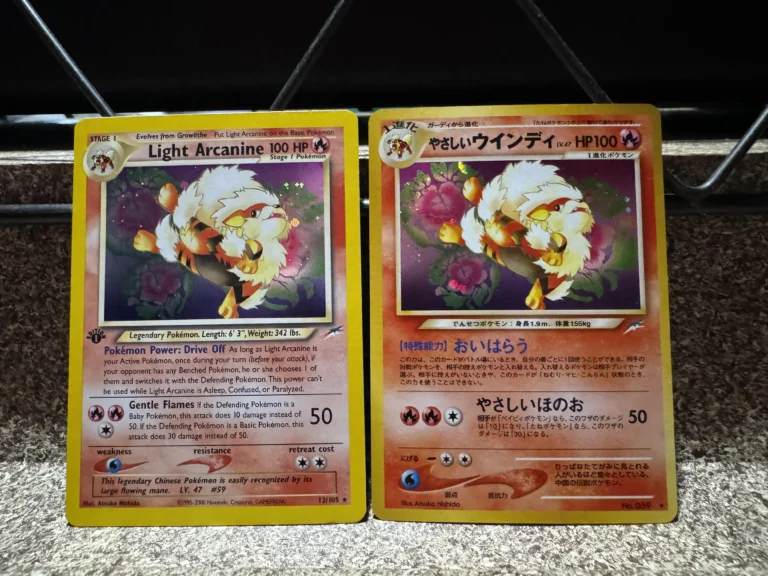
Japanese Pokémon cards have become much more than foreign-language versions of the cards sold in the US, UK, Australia and Europe.
For collectors, Japan is the original home of the Pokémon Trading Card Game and a market with its own sets, promotional cards, product formats, rarity systems and exclusive releases. Some Japanese cards later appear internationally in slightly different forms. Others remain exclusive to Japan.
That is also why collecting Japanese Pokémon cards can initially be confusing.
Is a Japanese card more valuable than the English version? What do AR, SAR and SR mean? How can you identify the set? Are Japanese booster boxes different? Can you play Japanese cards in tournaments outside Japan? And, perhaps most importantly, where can you safely buy them?
This guide explains the fundamentals of collecting Japanese Pokémon cards, whether you are considering your first Japanese booster box or trying to identify a card already in your collection.
Japanese Pokémon Cards at a Glance
Are Japanese Pokémon cards different from English cards?
Yes. Japanese and international Pokémon TCG releases do not always correspond one-to-one. Set composition, numbering, rarity, card finishes and promotional releases can differ.
Are Japanese Pokémon cards worth more?
Sometimes, but not automatically. Value depends on the individual card, rarity, demand, condition, artwork, availability and whether the release is genuinely exclusive or difficult to obtain.
Are there Pokémon cards exclusive to Japan?
Yes. Japan has received promotional cards, event distributions and products that have no direct international counterpart.
Are Japanese Pokémon cards legal in tournaments outside Japan?
Not necessarily. Play! Pokémon Championship Series rules restrict which card languages can be used according to the rating zone where an event takes place. Japanese is not among the standard permitted languages for Championship Series events in North America, Europe or Oceania. Local League and casual-event policies can differ.
Can you buy Japanese Pokémon cards outside Japan?
Yes. Japanese cards are sold through specialist stores and international marketplaces, and collectors can also purchase from Japan directly or use proxy-buying services.
What Are Japanese Pokémon Cards?
The Pokémon Trading Card Game was first released in Japan in 1996, before reaching the international market.
Today there are essentially parallel Pokémon TCG ecosystems. The Pokémon Company operates the Japanese card game, while The Pokémon Company International supports many of the international-language markets.
Even the manufacturing differs: Pokémon Support states that The Pokémon Company International prints English, French, Italian, German and Spanish cards in the United States or European Union, while The Pokémon Company in Japan supports Japanese-language cards.
That does not mean every Japanese card is fundamentally different from its English counterpart. Many cards share the same artwork and game mechanics.
The important point is that the Japanese and international product catalogues are not identical.
A Japanese expansion might later contribute cards to one or more international sets. Card numbers can differ. Rarity classifications may differ. Japan can receive promotional cards or special products unavailable internationally.
TCGplayer, which maintains a separate Pokémon Japan catalogue, explicitly notes that Japanese and English sets are not a one-to-one match and can have different card numbers, rarities, finishes, set codes and promos.
For a collector, that distinction is fundamental.
Japanese vs English Pokémon Cards
One of the first questions collectors ask is whether Japanese or English Pokémon cards are “better.”
There is no universal answer.
They belong to closely related but distinct markets, and each appeals to collectors for different reasons.
| Feature | Japanese Pokémon Cards | English Pokémon Cards |
|---|---|---|
| Language | Japanese | English |
| Product catalogue | Japanese releases | International releases |
| Set composition | Can differ from international sets | Often reorganizes Japanese releases |
| Card numbering | Japanese set numbering | International set numbering |
| Rarity system | Japanese rarity terminology | International rarity system |
| Exclusive promos | Numerous Japan-specific releases | Regional/international promos |
| Availability | Strongest in Japan | Much broader globally |
| Competitive use | Language restrictions apply outside Japan | English is accepted widely in major Western rating zones |
| Collector appeal | Japanese releases, exclusives, artwork, promos | Accessibility and larger Western player base |
Neither language automatically makes the same artwork rarer or more valuable.
In some cases, the Japanese version can command a premium. In others, the English version is significantly more expensive because international demand is stronger.
The correct comparison therefore needs to be made card by card rather than language by language.
For a deeper comparison of printing, rarity, prices and collecting, see our Japanese vs English Pokémon Cards guide.
RELATED
Japanese vs English Pokèmon Cards
Compare print quality, rarity systems, set structure, prices and collector appeal between Japanese and English releases.
How to Read a Japanese Pokémon Card
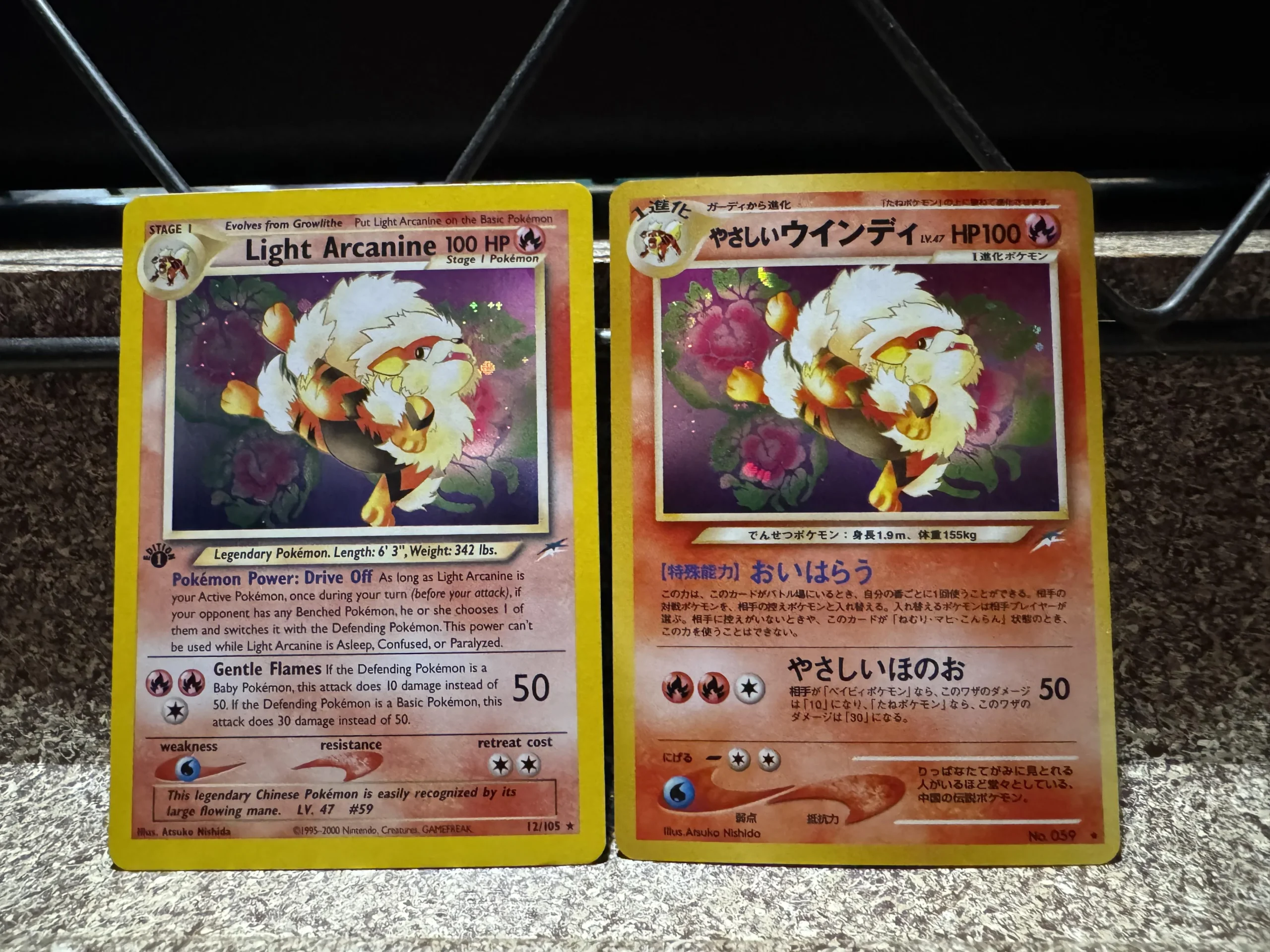
You do not need to understand Japanese to identify most Japanese Pokémon cards. Several pieces of information printed on the card can tell you exactly what you have.
If you want a step-by-step breakdown of every element printed on the card, read our guide on how to read Japanese Pokémon cards.
Pokémon Name
The Pokémon’s name is displayed prominently near the top of the card.
If you cannot read Japanese, visual identification is usually straightforward. Major databases and marketplaces typically list Japanese cards using the Pokémon’s English name; TCGplayer, for example, uses English Pokémon names within its Japanese catalogue.
Set Code
Modern Japanese cards normally include a set code near the bottom of the card.
This is often more useful than the Pokémon name when identifying the exact printing.
Two cards featuring the same Pokémon and even the same illustration can belong to different releases.
Collector Number
The collector number identifies the card’s position within the numbered portion of a set.
You might see something similar to:
067/062
A card numbered above the nominal set total is usually a clue that you are looking at one of the set’s higher-rarity or secret-numbered cards.
Do not use this rule by itself to determine value, however. Rarity systems have changed throughout the history of the Pokémon TCG.
Rarity
Japanese Pokémon cards commonly display a rarity designation near the collector information.
Depending on the era and set, these can include abbreviations such as:
- C
- U
- R
- RR
- AR
- SR
- SAR
- UR
We will explain these in more detail below.
Regulation Mark
Modern playable cards can also contain a regulation mark.
This is important for competitive players because Pokémon now uses regulation marks rather than simply expansion age to determine Standard-format rotation. For the 2026 Standard format, Pokémon states that cards bearing H, I and J regulation marks are legal, together with future marks that may subsequently be released.
Language legality is a separate issue, however, so a regulation-legal Japanese card is not automatically legal for use in every international tournament.
Illustrator
The illustrator credit appears at the bottom of the card.
For collectors interested in Pokémon artwork, this can be surprisingly important. Many people build collections around specific illustrators rather than sets or Pokémon species.

Japanese Pokémon Card Rarity Explained
The Japanese rarity system is one of the areas most likely to confuse new collectors. Rarity terminology has evolved across generations, so there is no single table that describes every Japanese Pokémon card ever released.
Modern Japanese cards can use rarity labels such as C, U, R, RR, AR, SR, SAR and UR. Our Japanese Pokémon Card Rarity Guide explains each category with examples and how the system has changed over time.
COLLECTOR GUIDE
Japanese Pokémon Card Rarity Explained
Learn what C, U, R, RR, AR, SR, SAR and UR mean—and why rarity does not always equal value.

For recent releases, however, collectors are likely to encounter categories such as:
C — Common
Cards intended to appear frequently within a set.
U — Uncommon
Less common than standard commons but still part of the regular set structure.
R — Rare
Traditional rare cards.
RR — Double Rare
Often associated with major Pokémon ex cards and similar higher-tier gameplay cards in modern sets.
AR — Art Rare
Illustration-focused cards featuring extended or highly distinctive artwork.
Art Rares have become particularly popular with collectors because many offer visually elaborate illustrations without necessarily belonging to the most expensive rarity tier.
SR — Super Rare
Higher-rarity cards that generally appear beyond the standard numbered portion of a set.
SAR — Special Art Rare
One of the most collector-focused modern rarity categories.
SAR cards combine high rarity with elaborate artwork and frequently feature Pokémon or Trainer cards presented in full illustrative scenes.
UR — Ultra Rare
A high-end rarity category that can include distinctive premium treatments.
The meaning and appearance of these categories can change between Pokémon TCG eras. Always identify the set and release year before evaluating a card based solely on its rarity symbol.
Our dedicated Japanese Pokémon Card Rarity Guide will cover rarity systems by era, including examples of AR, SAR, SR, UR and older Japanese classifications.

Japanese Pokémon Card Sets
Another major difference between Japanese and English Pokémon cards is the way expansions are organized.
International collectors sometimes assume that every Japanese set has an English set with exactly the same cards.
That is not how the system works.
TCGplayer specifically warns sellers that Japanese and English Pokémon sets are not one-to-one equivalents.
Japanese expansions can be smaller or structured differently, while international releases may combine cards originating from multiple Japanese products.
As a result, searching for an English set name is not always the best way to identify a Japanese card.
To browse releases chronologically, see our complete Japanese Pokémon card sets list.
Standard Expansion Packs
Japan regularly receives standard expansion packs containing randomly inserted cards from a particular release.
The official Japanese Pokémon Card Game product catalogue maintains these separately and lists Japanese release dates and suggested retail prices.
Enhanced and Special Expansions
Some Japanese releases use different product classifications from the standard expansion structure.
These can provide cards or treatments that eventually reach international sets through another release.
High Class Packs
Japan also releases products commonly referred to as High Class Packs.
These typically differ from ordinary expansion packs in card count, contents or product positioning.
For example, the official Japanese Pokémon TCG site classifies MEGA Dream ex as a High Class Pack and lists ten randomly inserted cards per pack.
Collectors therefore should not assume that a Japanese pack has the same structure or pull expectations as an English booster pack.
Our planned Complete Japanese Pokémon Card Sets in Order guide will provide a searchable chronological reference to the Japanese releases.
Are Japanese Pokémon Cards Worth More?
This is probably the most misunderstood question about Japanese Pokémon cards.
Japanese does not automatically mean valuable.
A Japanese card can be worth:
- more than its English equivalent,
- approximately the same amount,
- or considerably less.
The language alone does not determine value.
Instead, consider the following factors and if you are trying to identify the actual market price of a card, use our Japanese Pokémon Cards Value Guide rather than relying on seller asking prices.
Rarity
A genuinely scarce printing will normally have stronger collector potential than a mass-produced version of the same Pokémon.
But printed rarity and real-world scarcity are not always identical.
Pokémon
Demand is not evenly distributed.
Characters such as Pikachu, Charizard and other particularly popular Pokémon can attract much larger collector audiences.
Artwork
A highly desirable illustration can become a major factor in price.
This is particularly relevant to modern AR and SAR collecting.
Exclusivity
A card released only through a Japanese promotion or event can be fundamentally different from simply owning the Japanese-language version of an internationally available card.
This distinction matters enormously.
Distribution
Ask how collectors originally obtained the card.
Was it inside a normal booster?
Was it included with a product?
Was it given to participants at a Japanese event?
Was it part of a limited campaign?
The more restricted the original distribution, the more relevant scarcity may become.
For example, the official Japanese Pokémon Card Game ran a 2026 campaign distributing a Pikachu promo through eligible Pokémon Card Gym events across Japan.
Other promotional cards have been tied to Championship Points and competitive participation.
That distribution history is often much more meaningful than simply saying “the card is Japanese.”
Condition
Condition remains one of the biggest influences on collectible card prices.
Edges, corners, surface damage, scratches and print imperfections can all affect what collectors are willing to pay.
Grading
Professional grading can make comparisons easier and may increase liquidity for particularly desirable cards.
However, grading does not automatically make an inexpensive card valuable.
Market Demand
Ultimately, a card is worth what collectors are willing to pay.
That means recent completed sales are generally more useful than asking prices.
A seller can list a card for almost any amount. That does not mean someone is actually buying it for that price.
VALUE GUIDE
How Much Are Japanese Pokèmon Cards Worth?
Learn how to check recent sales, compare Japanese and English prices, and evaluate rarity, condition and exclusivity.

Japan-Exclusive Pokémon Cards and Promos
This is where Japanese Pokémon collecting becomes particularly interesting.
There is a meaningful difference between:
a Japanese-language version of a widely available card
and
a card or printing that was genuinely distributed only in Japan.
Japan regularly receives promotional releases connected with:
- Pokémon Center campaigns
- Pokémon Card Gym events
- tournaments
- Championship participation
- special products
- retail campaigns
- anniversaries
- collaborations
- magazines and other media
- limited events
TCGplayer confirms that certain Japanese cards, sets and promotional products have no English counterpart.
This is one of the strongest reasons to collect Japanese cards.
Instead of collecting every Japanese version of a card, some collectors specialize specifically in Japan-exclusive Pokémon promos.
That creates a collection with a clearer identity and often a much more interesting story behind each card.
We will explore these separately in Japan-Exclusive Pokémon Cards: The Collector’s Guide.
Japanese Pokémon Booster Packs and Booster Boxes
Buying sealed Japanese Pokémon products is another popular route into the hobby.
But there is an important rule:
Do not assume Japanese sealed products work like English products.
Pack sizes, box configurations and product categories can differ.
Japan has its own official product structure, including standard expansion packs, special products and High Class Packs.
Collectors should therefore check the specifications of the exact Japanese product before buying it.
If you are considering sealed products, see our guide to the best Japanese Pokémon booster boxes before buying.
This is especially important when sellers use phrases such as:
- “Japanese booster box”
- “High Class Pack”
- “special set”
- “exclusive Japanese box”
without clearly explaining what the product contains.
Before buying sealed Japanese Pokémon cards, check:
- the exact Japanese set name;
- the set code;
- the original release date;
- the number of packs in the product;
- the number of cards per pack;
- whether the product was originally shrink-wrapped;
- the seller’s reputation;
- whether the price is realistic compared with the Japanese market.
You should also understand how importing sealed products from Japan works before comparing prices. We explain in this guide how to buy Pokèmon cards from Japan.
How to Tell if Japanese Pokémon Cards Are Fake
The growth of Pokémon collecting has also created a large counterfeit market.
Japanese cards are not immune.
A fake card may initially look convincing, particularly when viewed through marketplace photographs.
Warning signs can include:
- poor or blurry printing;
- incorrect fonts;
- unusual colors;
- inaccurate holofoil patterns;
- missing or incorrect texture;
- suspicious card stock;
- incorrect set codes;
- incorrect numbering;
- inconsistent rarity symbols;
- errors in Japanese text;
- unusually cheap prices;
- sellers using only generic or stock images.
However, there is no single “fake test” that works for every Pokémon card ever produced.
For visual comparisons and a full authenticity checklist, read how to tell if Japanese Pokémon cards are fake.
Production methods and card finishes vary across eras.
The safest approach is therefore to compare a suspicious card with verified examples from the same set and printing, not simply with another random Pokémon card.
For expensive purchases, seller provenance is also important.
Where to Buy Japanese Pokémon Cards
Collectors outside Japan have several ways to buy Japanese Pokémon cards.
Specialist Pokémon and TCG Stores
This is often the simplest option.
A reputable specialist has already handled importing, international payment and logistics.
The trade-off is that prices may be higher than buying directly in Japan.
International Marketplaces
Major card marketplaces increasingly support Japanese Pokémon products.
TCGplayer, for example, now maintains a dedicated Pokémon Japan product line and continues adding Japanese sets to its catalogue.
Marketplaces can make price comparison easier, but always examine seller reputation, photographs and card condition.
Japanese Card Shops
Japan has an enormous physical and online trading-card ecosystem.
Buying from Japanese sellers can provide access to cards and products that are less common internationally.
The difficulty is that some Japanese stores are designed primarily for domestic customers.
Japanese Marketplaces
Domestic resale platforms can be particularly interesting for singles, collections and discontinued products.
However, international buyers may encounter restrictions involving:
- Japanese addresses;
- domestic payment methods;
- account creation;
- seller policies;
- international shipping.
Buying directly from Japan can give collectors access to a much wider selection, but domestic marketplaces are not always designed for international buyers. Our guide on how to buy Pokémon cards from Japan explains the process step by step.
That leads to another option.
Proxy Buying Services
A proxy service acts as an intermediary between the international collector and a Japanese store or marketplace.
In a typical transaction:
- you select an item in Japan;
- the proxy purchases it on your behalf;
- the seller ships it to the proxy’s Japanese warehouse;
- your purchases can sometimes be consolidated;
- the proxy ships the package internationally.
Proxy buying can significantly widen the range of Japanese Pokémon cards accessible to overseas collectors.
It does not automatically make every purchase cheaper, however.
You must account for:
- domestic Japanese shipping;
- proxy fees;
- consolidation fees;
- international shipping;
- taxes;
- customs or import charges where applicable.
If you plan to use Mercari Japan, Yahoo! Auctions or Japanese card shops, you may need a proxy buying service so I recommend to check out the best proxy buying services for Japan.
BUYING FROM JAPAN
How to Buy Pokémon Cards Directly From Japan
Learn how Japanese marketplaces, proxy services, shipping, consolidation and import costs work before you place an order.
How to Start Collecting Japanese Pokémon Cards
A new collector does not need to begin with the rarest cards.
In fact, choosing a clear collecting theme is usually more satisfying than simply buying whatever appears to be valuable.
Here are several possible approaches.
Collect Your Favorite Pokémon
This is one of the easiest ways to begin.
Choose Pikachu, Eevee, Gengar, Mew, Psyduck—or whichever Pokémon you actually enjoy—and explore its Japanese releases over the years.
Collect by Illustrator
Pokémon cards have become a major showcase for Japanese illustration.
Following particular artists can turn a collection into something closer to an art archive.
Collect AR and SAR Cards
Modern illustration rarities offer an approachable entry into visually focused collecting.
Collect Japanese Promos
For collectors interested in Japan specifically, this may be the most distinctive route.
Promotional cards often come with stories connected to Japanese events, stores, campaigns and Pokémon culture.
Complete a Japanese Set
Set collecting provides a clear goal.
Before beginning, however, check exactly which cards belong to the master set and whether parallel, secret or promotional cards are included in your definition of “complete.”
Collect Sealed Products
Some collectors prefer unopened booster boxes and special products.
If you follow this route, learn how the original product was packaged before purchasing from the secondary market.
Should You Grade Japanese Pokémon Cards?
Professional grading is particularly popular for collectible Pokémon cards.
Companies such as PSA and CGC authenticate the card, evaluate its condition and encapsulate it in a protective holder.
Grading can make sense when:
- the card has meaningful market value;
- condition is unusually strong;
- authentication is important;
- you plan to sell internationally;
- the graded version has an established collector market.
It may make less sense when:
- the card is inexpensive;
- grading and shipping costs approach the card’s value;
- you prefer binder collecting;
- the card has visible damage;
- there is little demand for graded copies.
Before submitting anything, compare recent selling prices for both raw and graded examples of the same Japanese printing.
Do not compare the Japanese version with an unrelated English version and assume the same grading premium will apply.
Before submitting a card, read our guide to grading Japanese Pokémon cards.
Can You Use Japanese Pokémon Cards in Tournaments?
This requires a little nuance.
There are two separate questions:
- Is the card itself legal in the format?
- Is the language permitted at that event?
For the 2026 Standard format, cards with regulation marks H, I and J are legal, along with later marks as they become available. Older cards can sometimes remain usable when an equivalent currently legal printing exists.
But language rules are separate.
For Play! Pokémon Championship Series events, legal languages depend on the rating zone.
The tournament rules list:
- North America: English
- Europe: English, French, German, Italian, Portuguese and Spanish
- Oceania: English
Japanese therefore is not ordinarily a permitted card language for Championship Series events in those regions.
Different rules or exceptions can apply to certain major events, regions and local non-Championship tournaments, and tournament documents are periodically updated. Pokémon published another rules update in September 2026, reinforcing the importance of checking the current handbook before competing.
Collectors buying Japanese cards primarily for competitive play should therefore verify the rules for their specific event before building a deck.
Are Japanese Pokémon Cards Better Quality?
You will frequently see collectors claim that Japanese Pokémon cards are universally “better quality” than English cards.
That statement is too broad.
The cards are produced through different manufacturing operations, and collectors may notice differences in printing, texture, finish or consistency between particular Japanese and international releases.
But quality should be evaluated by the specific set and card, not treated as an absolute characteristic of an entire language.
The same applies to centering and grading.
A Japanese card can have excellent production quality and still receive a poor grade because of damage, centering or surface issues.
Buy the card in front of you—not the reputation of the language printed on it.
Are Japanese Pokémon Cards a Good Investment?
Pokémon cards are collectibles, not guaranteed financial investments.
Prices can increase dramatically, but they can also decline.
Modern products can be reprinted. Collector interest changes. Pokémon popularity varies by character and set. Transaction fees, grading costs and shipping can also substantially reduce any apparent profit.
If financial value matters to you, focus on evidence rather than hype:
- actual completed sales;
- genuine scarcity;
- distribution history;
- long-term collector demand;
- condition;
- population reports for graded cards;
- differences between asking prices and selling prices.
Most importantly, collect cards you would still be happy to own if their market price fell.
Japanese Pokémon Cards FAQ
Why are some Japanese Pokémon cards cheaper than English cards?
Because price reflects supply and demand within each market. A card can be abundant in Japan but highly desirable internationally, or an English release can attract stronger demand from the much larger English-speaking player and collector base.
There is no rule stating that Japanese cards should always cost more.
Why are some Japanese Pokémon cards more expensive?
Japan-exclusive promos, limited distributions, desirable artwork, scarce releases and historically important cards can create premiums.
The key is why that specific printing is scarce or desirable.
What does AR mean on a Japanese Pokémon card?
AR generally stands for Art Rare, a modern rarity focused on illustration artwork.
What does SAR mean?
SAR stands for Special Art Rare, a higher-rarity category featuring elaborate full-card illustrations. See our Japanese Pokémon Card Rarity Guide for the full rarity system.
What is a Japanese High Class Pack?
High Class Pack is a Japanese Pokémon TCG product category distinct from ordinary expansion packs. Contents and pack configurations vary by product. The official Japanese catalogue explicitly labels releases such as MEGA Dream ex as High Class Packs.
Do Japanese and English Pokémon sets contain the same cards?
Not always. See Japanese vs English Pokémon Cards for a full comparison.
Are there Pokémon cards that were only released in Japan?
Yes. Japan has received cards, promotional releases and products without direct English equivalents.
Can PSA grade Japanese Pokémon cards?
Yes. Japanese Pokémon cards are widely submitted to professional grading companies.
Can I buy Pokémon cards directly from Japan?
Yes. See our complete guide to buying Pokémon cards from Japan.
Are Japanese Pokémon cards legal in the US?
For collecting and casual play, there is nothing unusual about owning Japanese cards. For official competitive play, however, language restrictions apply. Japanese is not one of the standard legal languages for North American Play! Pokémon Championship Series events.
Are Japanese Pokémon cards legal in Europe?
Not normally for Championship Series play. Europe’s listed Championship Series languages include English, French, German, Italian, Portuguese and Spanish, but not Japanese. Check current tournament documentation for exceptions and local-event policies.
Why Collect Japanese Pokémon Cards?
Japanese Pokémon cards offer something that goes beyond simply collecting the same cards in another language.
They provide a way to explore the Pokémon TCG through the market where it began.
Japanese expansions can be structured differently. Promotional cards can tell the story of events and campaigns that never existed overseas. High Class Packs and special products give collectors different ways to approach sealed collecting. And many cards become fascinating precisely because their Japanese release history differs from what international collectors know.
You do not need to collect everything.
Start with a Pokémon, an illustrator, a Japanese set, a group of Art Rares or an unusual promotional series.
Then learn how that part of the Japanese Pokémon TCG fits into the wider history of the game.
That is where collecting Japanese Pokémon cards becomes much more interesting than simply asking whether the Japanese version is worth more.
Continue Exploring Japanese Pokémon Cards
- Japanese Pokémon Card Rarity Guide
- Japanese vs English Pokémon Cards
- Japanese Pokémon Cards Value Guide
- Japanese Pokémon Sets in Order
- How to Tell if Japanese Pokémon Cards Are Fake
- How to Buy Pokémon Cards From Japan
- Best Japanese Pokémon Booster Boxes
- Japan-Exclusive Pokémon Cards