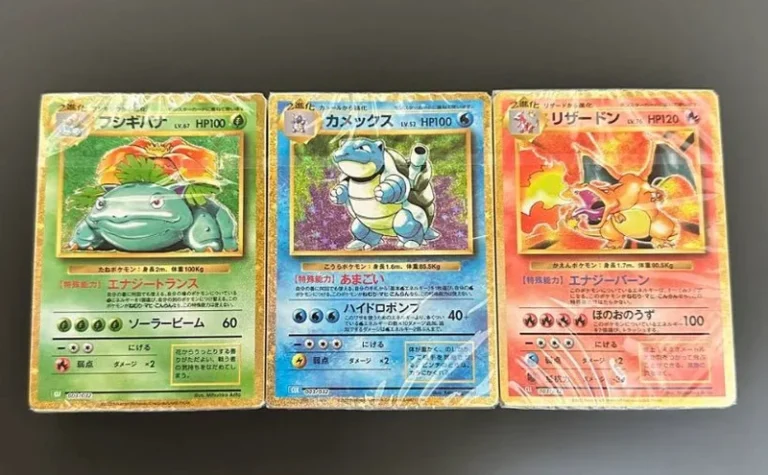
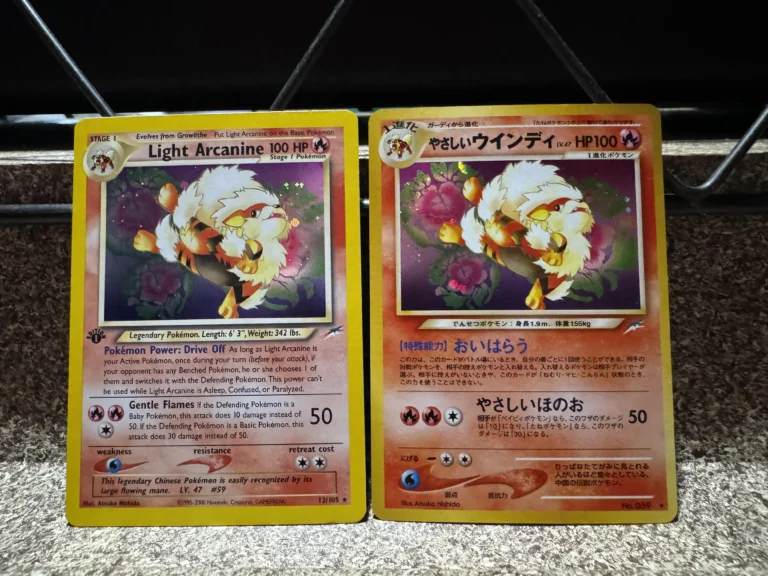
If you have ever looked at a Japanese Pokémon card and wondered what AR, SAR, SR, UR or MUR means, you are not alone.
If you’re completely new to cards from Japan, read our complete guide to Japanese Pokèmon Cards first.
Japanese Pokémon cards use rarity codes that can be confusing for collectors familiar with English cards. To make matters more complicated, the system has changed several times throughout the history of the Pokémon TCG, and recent releases have introduced entirely new rarity categories.
The good news is that modern Japanese cards are usually quite easy to identify once you know where to look.
This guide explains the Japanese Pokémon card rarity system, including the standard modern rarities, special MEGA-era rarities, older codes you may encounter and how Japanese rarity names compare with English Pokémon cards.
Japanese Pokémon Card Rarity Chart
For many modern Japanese sets, these are the rarity codes you will encounter most often:
| Code | Japanese Rarity | Typical Role |
|---|---|---|
| C | Common | Basic cards appearing frequently |
| U | Uncommon | Less common regular-set cards |
| R | Rare | Rare cards |
| RR | Double Rare | Often Pokémon ex |
| AR | Art Rare | Illustration-focused collectible cards |
| SR | Super Rare | Higher-rarity full-art cards |
| SAR | Special Art Rare | Premium illustration cards |
| UR | Ultra Rare | Usually premium gold-style cards |
These eight codes form the most useful starting point for understanding modern Japanese Pokémon cards.
However, they are not the complete Pokémon rarity system.
Current and recent Japanese products also use special categories including MA, MUR, BWR and FUR, while older eras introduced codes such as RRR, HR, CHR, CSR, S and SSR.
Where Is the Rarity on a Japanese Pokémon Card?
On most modern Japanese Pokémon cards, the rarity code appears near the collector number at the bottom of the card.
You might see something similar to:
067/062 AR
or:
091/071 SAR
The letters tell you the card’s rarity.
The numbers tell you something different.
In:
067/062
67 is the individual card number and 62 is the advertised size of the main numbered set.
This means the card is numbered beyond the regular set total.
TCGplayer similarly explains that Pokémon collector numbers generally use the format XXX/YYY and that the first number can exceed the advertised set total for higher-rarity cards. TCGplayer
That distinction is important:
Collector number and rarity are related, but they are not the same thing.
Always look at both.
C — Common
C stands for Common.
These are among the most frequently encountered cards in a normal Japanese expansion.
Common cards typically include basic Pokémon and other cards that form the foundation of the set.
Being Common does not necessarily mean a card is undesirable.
Collectors may still seek Common cards because of:
- a popular Pokémon;
- an illustrator they collect;
- a complete set;
- unusual artwork;
- an older or historically important printing.
Rarity describes the card’s position within the product—not how much collectors will necessarily pay for it.
U — Uncommon
U means Uncommon.
These cards generally appear less frequently than Commons but remain part of the standard set structure.
Trainer cards and evolved Pokémon commonly appear at this level, although exact set composition varies.
Again, rarity and value should not be confused.
An older Uncommon card in excellent condition can sometimes be more desirable than a much newer higher-rarity card.
R — Rare
R means Rare.
Rare cards sit above Common and Uncommon cards in the basic rarity hierarchy.
Depending on the Pokémon TCG era and expansion, their foil treatment and appearance can vary.
This is one reason you should avoid identifying an older Japanese Pokémon card solely by how shiny it looks.
The printed rarity code and exact set are more reliable.
RR — Double Rare
RR means Double Rare.
In modern Japanese sets, RR is commonly associated with Pokémon ex and other important gameplay cards.
It is a step above standard Rare cards but should not be confused with the higher collector-oriented rarities such as AR, SR or SAR.
A Pokémon ex can therefore exist in more than one version within the same expansion:
- its normal RR printing;
- an SR version;
- potentially a SAR version;
- and, depending on the set, another premium rarity.
This is one of the main reasons the exact card number matters when checking prices.
Searching only for the Pokémon’s name may mix several completely different versions together.
AR — Art Rare
AR stands for Art Rare.
This rarity has become one of the most popular categories among modern Japanese Pokémon collectors.
Art Rares focus heavily on illustration. Instead of presenting the Pokémon in a conventional card frame, the artwork often extends across much of the card and depicts the Pokémon inside a larger scene.
Pokémon officially introduced AR and SAR with VSTAR Universe in December 2022, describing them as new rarity categories focused on the Pokémon’s personality and the illustrator’s work. Pokemon Card
AR cards might show:
- Pokémon interacting with their environment;
- everyday scenes;
- unusual visual perspectives;
- connections between multiple cards;
- highly distinctive illustrator styles.
Is an AR card automatically expensive?
No.
AR describes rarity and presentation—not market price.
Some AR cards remain inexpensive despite attractive artwork because supply is relatively high.
Others become much more valuable because they feature popular Pokémon or especially desirable illustrations.
This is a recurring rule throughout Pokémon collecting:
Rarity influences value. It does not determine value by itself.
SR — Super Rare
SR stands for Super Rare.
SR cards have existed across multiple Pokémon TCG eras, although their appearance has changed.
The Japanese Pokémon TCG officially describes SR cards as unusually rare cards featuring larger artwork and special surface treatments. Pokemon Card
In modern sets, SR frequently includes full-art versions of Pokémon ex and Trainer cards.
An important terminology trap appears when comparing Japanese and English cards.
A Japanese SR (Super Rare) can correspond broadly to what the English Pokémon TCG calls an Ultra Rare.
So:
Japanese SR ≠ English name “Super Rare”
This is why simply translating rarity names literally can create confusion.
We will come back to this when comparing Japanese and English rarities.
SAR — Special Art Rare
SAR stands for Special Art Rare.
For many collectors, this is one of the most desirable modern Japanese rarity categories.
Like AR cards, SAR cards emphasize illustration, but they typically apply premium artwork and treatment to cards such as Pokémon ex or important Trainer cards.
The category debuted alongside AR in VSTAR Universe in 2022. Pokemon Card
Japanese Pokémon product pages continue to highlight SAR cards as major attractions in modern expansions. Pokemon Card
In English releases, the closest equivalent is generally called:
Special Illustration Rare, often abbreviated by collectors as SIR.
So you may see the same basic artwork described online as:
SAR — Japanese
and
SIR — English
That does not mean the cards necessarily have identical numbering, printing or market value.
UR — Ultra Rare
UR means Ultra Rare in the Japanese Pokémon TCG.
These cards frequently use premium gold-colored designs or finishes.
Historically, Pokémon’s official Japanese site has described UR cards as cards with gold-shining borders and positioned them among the highest rarities of the relevant sets. Pokemon Card
But this creates another major naming trap.
Japanese UR is not the same terminology as English Ultra Rare.
In recent English sets, cards comparable to many Japanese UR cards are generally categorized as Hyper Rare.
Meanwhile, what English collectors call an Ultra Rare often corresponds more closely to Japanese SR.
That means:
| Japanese | Approximate English terminology |
|---|---|
| AR | Illustration Rare |
| SR | Ultra Rare |
| SAR | Special Illustration Rare |
| UR | Hyper Rare |
Treat this as a practical comparison rather than a universal conversion table.
Japanese and international Pokémon sets are not always one-to-one equivalents, so there can be exceptions.
The Newer Japanese Pokémon Rarities: MA, MUR, BWR and FUR
This is where an article dedicated to rarity becomes especially useful.
The Pokémon TCG has continued introducing new rarity categories, particularly from 2025 onward.
A guide that stops at AR, SAR and UR is no longer complete in 2026.
MA — Mega Attack Rare
MA stands for Mega Attack Rare.
This rarity belongs to the Pokémon TCG MEGA era and focuses on Mega Evolution Pokémon performing powerful attacks.
Pokémon officially announced MA in 2025 as a new rarity featuring Mega Evolution Pokémon using their moves, and later highlighted MA cards in the Japanese MEGA Dream ex High Class Pack. Pokemon Card
Unlike the basic C → UR hierarchy, MA is better understood as a special thematic rarity associated with particular products and card designs.
The official international Pokémon card database also recognizes Mega Attack Rare as its own rarity category. Pokemon
MUR — Mega-Era Premium Rarity
You may also encounter the code:
MUR
on recent Japanese and Asian Pokémon cards.
The official Pokémon Asian card database now includes MUR as a searchable rarity category, alongside MA, BWR, SAR, AR and UR. asia.pokemon-card.com
Collectors commonly refer to MUR as Mega Ultra Rare.
In corresponding international MEGA-era releases, Pokémon’s official English-language database uses the category Mega Hyper Rare for premium gold Mega Evolution cards. Examples include Mega Lucario ex, Mega Charizard X ex and Mega Darkrai ex. Pokemon
The important collector lesson is not simply memorizing the name.
It is recognizing that MUR is a different rarity from the older Japanese UR category.
When pricing a modern Mega Evolution card, search using:
Pokémon name + set code + collector number + MUR
rather than simply searching for “gold Japanese Pokémon card.”
BWR — Black White Rare
BWR was introduced with the Japanese Black Bolt and White Flare expansions in 2025.
The official Japanese Pokémon site specifically identified Zekrom ex and Reshiram ex as BWR cards, featuring distinctive black- and white-focused designs associated with their respective sets. Pokemon Card
The official international Pokémon database now lists the corresponding rarity as Black White Rare. Pokemon
This is another example of why Japanese Pokémon rarity is not simply a permanent ladder from lowest to highest.
Some rarities are strongly tied to a particular release or design concept.
FUR — Futuristic Rare
The latest major addition as of October 2026 is:
FUR — Futuristic Rare.
FUR debuted in Pokémon TCG: 30th Celebration, released on September 16, 2026.
The official Japanese 30th Celebration site describes FUR as a new rarity and identifies Mew ex and Mewtwo ex, illustrated by graphic artist YOSHIROTTEN, as the first featured cards. ポケモンカードゲーム30周年特別サイト
The international Pokémon database likewise recognizes Futuristic Rare as an official rarity category. Pokemon
This is exactly the sort of category that older Pokémon rarity guides will miss.
Pikachu Rare and Other Set-Specific Categories
30th Celebration introduced another special collecting category:
Pikachu Rare.
The expansion contains 30 different Pikachu Rare cards, one representing each year of Pokémon’s history at the time of the anniversary. Pokémon confirms that every 30th Celebration booster contains a Pikachu card and that there are 30 Pikachu Rare designs to collect. Pokemon
These cards show why it is better to think of Pokémon rarity as:
a core rarity system + special rarity categories
rather than one simple permanent ladder.
Older Japanese Pokémon Rarity Codes
If you collect Japanese cards from older Pokémon TCG eras, you will encounter additional rarity codes.
They should not automatically be compared with modern AR, SAR or MUR cards.
The official Pokémon card databases still recognize many historical rarity categories, including:
RRR
HR
S
SSR
K
TR
PR
among others. asia.pokemon-card.com
Some especially important older categories include the following.
RRR — Triple Rare
RRR appeared prominently during the Sword & Shield era.
Pokémon VMAX cards, for example, could carry the RRR designation, and official Pokémon documentation from that period identifies cards using the RRR rarity. Pokemon Card
Do not assume that RRR is simply “one level above RR” in every modern product.
Rarity systems change with Pokémon TCG eras.
HR — Hyper Rare
HR was used as a Japanese rarity during previous eras.
During the Sun & Moon period, for example, Pokémon’s Japanese site described HR cards as special rainbow-colored rare cards positioned above SR in those releases. Pokemon Card
This creates another naming complication:
Japanese historical HR and modern English Hyper Rare should not automatically be treated as the same product category.
Always consider the set and era.
CHR — Character Rare
CHR means Character Rare.
These cards became particularly associated with artwork showing Pokémon together with Trainers.
The Japanese VMAX Climax High Class Pack prominently featured CHR cards and officially described them as cards depicting Pokémon and their Trainers together. Pokemon Card
Many of these cards became highly popular with illustration-focused collectors.
CSR — Character Super Rare
CSR means Character Super Rare.
VMAX Climax introduced both CHR and CSR cards, with CSR used for premium versions involving Pokémon V or VMAX alongside their Trainers. Pokemon Card
CHR and CSR are useful examples of historical rarity names that collectors will still encounter even though newer sets use different terminology.
S and SSR — Shiny Rarities
High Class Packs have also used dedicated rarity categories for shiny Pokémon.
Shiny Star V, for example, included shiny Pokémon as well as cards explicitly labelled SSR in Pokémon’s official Japanese card resources. Pokemon Card
These categories are closely associated with particular eras and products and should not be forced into the current AR/SAR hierarchy.
Japanese vs English Pokémon Card Rarity
This is one of the easiest areas for collectors to misunderstand.
Japanese and English Pokémon cards can use different names for comparable rarity treatments.
A useful modern reference is:
| Japanese | English equivalent commonly used |
|---|---|
| C | Common |
| U | Uncommon |
| R | Rare |
| RR | Double Rare |
| AR | Illustration Rare |
| SR | Ultra Rare |
| SAR | Special Illustration Rare |
| UR | Hyper Rare |
| MA | Mega Attack Rare |
| MUR | Mega Hyper Rare in corresponding English MEGA releases |
| BWR | Black White Rare |
| FUR | Futuristic Rare |
Pokémon’s current international card database itself lists categories including Illustration Rare, Special Illustration Rare, Hyper Rare, Black White Rare, Mega Hyper Rare, Mega Attack Rare, Pikachu Rare and Futuristic Rare. Pokemon
But remember:
This table is a translation aid, not proof that two cards are identical.
Japanese and international sets can have different numbers, finishes, products and set structures. Learn everything about the difference between cards in our Japanese vs English Pokèmon Cards Guide.
What Does a Card Number Higher Than the Set Total Mean?
Suppose your Japanese card reads:
091/071
The main numbered set contains 71 cards, but your card is number 91.
That means it sits beyond the advertised base-set numbering.
Collectors frequently call cards like these secret rares or secret-numbered cards.
However:
“Secret Rare” is not one single Japanese rarity.
Several different rarity types can appear above the set’s printed total.
Depending on the expansion, these may include:
- AR;
- SR;
- SAR;
- UR;
- MUR;
- other special rarities.
So do not price a card simply because:
“The first number is higher than the second.”
Instead identify the actual rarity code.
Does Higher Rarity Mean Higher Value?
Not necessarily.
Imagine two cards:
Card A: UR
Card B: SAR
The UR may technically occupy a higher or more premium rarity position in a particular set.
But collectors might strongly prefer the SAR because:
- it features Charizard or Pikachu;
- the artwork is more popular;
- the illustrator has a following;
- demand is much stronger.
The SAR could therefore sell for considerably more.
Market value depends on multiple factors:
rarity + Pokémon + artwork + demand + scarcity + condition + distribution
—not rarity alone.
This is why our separate Japanese Pokémon Cards Value Guide will focus on actual pricing rather than rarity labels.
How to Identify a Japanese Pokémon Card’s Rarity in 30 Seconds
When you have an unfamiliar Japanese card in front of you, use this process.
1. Find the set code
Look near the bottom of the card.
This identifies the expansion or product.
2. Find the collector number
For example:
113/076
Record both numbers.
3. Find the rarity code
Look for:
AR
SAR
SR
MUR
or another designation next to the collector information.
4. Search the exact combination
Instead of:
Japanese Rayquaza card
search for:
Rayquaza + set code + 113/076 + MUR
This dramatically reduces the chance of confusing several printings.
5. Compare the exact card
Check artwork, number, set code and rarity—not just the Pokémon’s name.
This becomes particularly important with Pokémon that have dozens or even hundreds of different cards.
Is SAR Rarer Than AR?
Generally, SAR is positioned as a more premium rarity than AR in modern Japanese sets.
AR cards are illustration-focused versions of standard Pokémon, while SAR is used for higher-end special illustration treatments.
But rarity availability and pack configuration depend on the specific expansion.
Avoid applying one unofficial “1 in X packs” pull rate to every Japanese set.
Is UR Better Than SAR?
Not necessarily.
UR is a distinct premium rarity, often associated with gold treatments.
SAR emphasizes special illustration artwork.
Depending on the card and collector demand, either can be more valuable.
A popular SAR can easily have a higher secondary-market price than a less desirable UR.
What Is the Rarest Japanese Pokémon Card Rarity?
There is no single rarity code that has been the permanent “rarest Pokémon rarity” throughout the game’s history.
The answer changes by:
- era;
- set;
- product type;
- special promotion.
As of 2026, current products can include premium or special categories such as MUR, BWR and FUR, while earlier eras used categories such as HR, CSR and SSR.
And some of the rarest Pokémon cards are promotional cards whose scarcity comes from how they were distributed, not from a booster-pack rarity symbol at all.
Do Promo Cards Have Normal Rarity Codes?
Not always.
Promotional cards can follow their own numbering and identification systems.
Their scarcity may depend on whether they were distributed through:
- tournaments;
- Pokémon Centers;
- campaigns;
- magazines;
- product bonuses;
- limited events.
For these cards, understanding distribution can be more important than looking for C, R or SAR.
This is one reason Japan-exclusive Pokémon promos deserve their own collector guide.
Japanese Pokémon Card Rarity FAQ
What does AR mean on a Japanese Pokémon card?
AR means Art Rare, a modern rarity focused on illustration artwork.
What does SAR mean?
SAR means Special Art Rare, a premium illustration rarity introduced alongside AR in VSTAR Universe.
What does SR mean?
SR means Super Rare. In modern Japanese sets it often applies to higher-rarity full-art Pokémon or Trainer cards.
What does UR mean?
UR means Ultra Rare in Japanese sets and is often associated with premium gold treatments.
What does RR mean?
RR means Double Rare and is commonly used for Pokémon ex in modern Japanese expansions.
What does MUR mean?
MUR is a modern MEGA-era Japanese/Asian rarity code commonly referred to by collectors as Mega Ultra Rare. Comparable international cards are categorized by Pokémon as Mega Hyper Rare.
What is FUR?
FUR means Futuristic Rare. It debuted in 30th Celebration in September 2026, with Mew ex and Mewtwo ex among the first FUR cards. ポケモンカードゲーム30周年特別サイト
What is BWR?
BWR is the special rarity introduced with Black Bolt and White Flare, including cards such as Zekrom ex and Reshiram ex. The international rarity name is Black White Rare. Pokemon Card
Is SAR always worth more than SR?
No. SAR is generally a more premium modern rarity treatment, but market value depends on the individual card and collector demand.
Does a number such as 091/071 mean the card is rare?
It shows that the card is numbered beyond the advertised base set, which is common among higher-rarity cards. You still need to check the actual rarity code.
Are Japanese rarity symbols the same as English Pokémon cards?
Not always. Modern Japanese cards frequently use letter codes such as AR, SR and SAR, while international sets use terms such as Illustration Rare, Ultra Rare and Special Illustration Rare.
Understanding Rarity Is Only the First Step
Japanese Pokémon card rarity looks complicated because the Pokémon TCG has changed its system repeatedly over three decades.
Fortunately, identifying a modern card is usually straightforward:
find the set code → read the collector number → identify the rarity code.
For most modern Japanese cards, start by learning:
C → U → R → RR → AR → SR → SAR → UR
and then understand that special products can introduce additional categories such as:
MA → MUR → BWR → FUR.
Older cards require more attention because previous Pokémon TCG eras used systems including HR, RRR, CHR, CSR, S and SSR.
Most importantly, remember that rarity and value are not the same thing.
The rarity tells you what version of the card you have.
Collector demand tells you how desirable that version actually is.
Continue Exploring Japanese Pokémon Cards
Japanese Pokémon Cards: The Complete Collector’s Guide
Japanese vs English Pokémon Cards
Japanese Pokémon Cards Value Guide
Japanese Pokémon Sets in Order
How to Tell if Japanese Pokémon Cards Are Fake