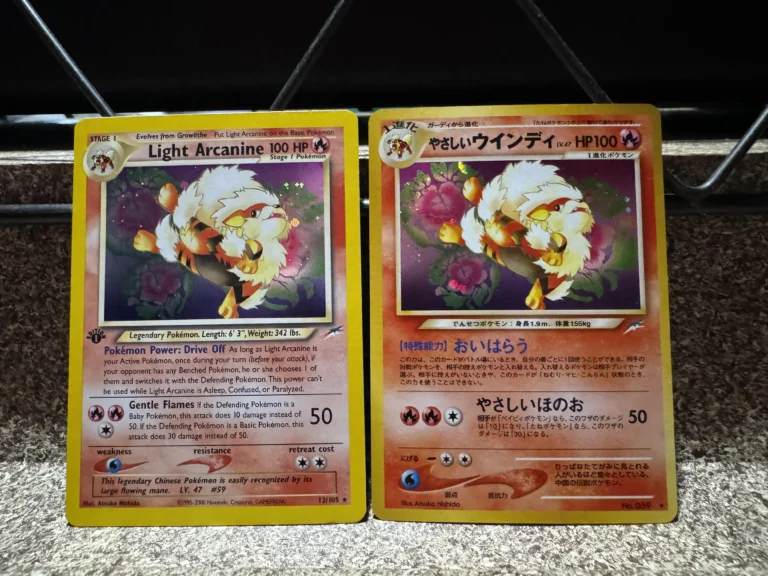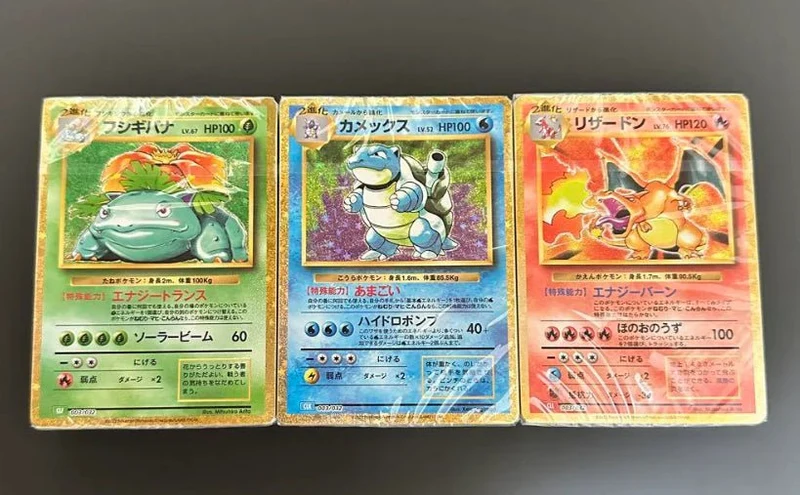
You find an old Japanese Pokémon card in a binder, spot a Special Art Rare in a booster pack, or see a Japanese Charizard online for a fraction of the price of the English version.
The obvious question is:
How much is this Japanese Pokémon card actually worth?
There is no single price range that applies to Japanese Pokémon cards.
Most are inexpensive. Some modern chase cards sell for hundreds of dollars. Rare vintage cards, tournament prizes and limited Japanese promos can reach thousands—or far more.
As a useful snapshot, CardTrack currently tracks more than 20,000 Japanese cards with raw market prices. Its data shows a median raw value of about $2.54, with roughly 64% priced below $5. At the other end of the market, more than 1,000 tracked cards are valued above $100 raw and around 160 exceed $1,000. CardTrack
So the correct question is not:
Are Japanese Pokémon cards valuable?
It is:
Which exact Japanese Pokémon card do I have, and what have buyers recently paid for that printing?
This guide shows you how to answer that.
If you are completely new to Japanese cards, start with our Complete Guide to Japanese Pokémon Cards.
Are Japanese Pokémon Cards Worth Anything?
Yes—but being Japanese does not automatically make a Pokémon card valuable.
A modern Japanese Common may be worth less than a few dollars.
A desirable Art Rare or Special Art Rare might command considerably more.
A scarce vintage holo, Japanese-exclusive promo or trophy card can belong to an entirely different price category.
The value comes from a combination of:
- the exact card;
- set and printing;
- rarity;
- age;
- distribution;
- condition;
- grading;
- Pokémon popularity;
- artwork;
- collector demand;
- current supply.
This is why two Japanese cards sitting next to each other in the same binder can have wildly different values.
The Fastest Way to Check a Japanese Pokémon Card’s Value
Before looking at prices, identify the card correctly.
This sounds obvious, but it is probably the most important part of the entire process.
The same Pokémon can appear in dozens—or hundreds—of different cards.
And Japanese and English sets are not always direct equivalents. TCGplayer specifically notes that cards sharing artwork can have different Japanese set codes, numbers, rarities and finishes. TCGplayer
Use these four pieces of information.
1. Pokémon Name
You can usually identify the Pokémon visually even if you cannot read Japanese.
Major databases such as TCGplayer list Japanese cards using the Pokémon’s English name, so you do not necessarily need to type Japanese characters. TCGplayer
But the name alone is not enough.
2. Set Code
Look near the bottom of the card for an alphanumeric set code.
This is one of the strongest identifiers of the exact Japanese release.
3. Collector Number
You might see something like:
205/172
or:
091/071
Record both numbers.
A Pokémon may have several cards in the same era, so the collector number can immediately distinguish one version from another.
4. Rarity Code
Modern Japanese cards can display codes such as:
C, U, R, RR, AR, SR, SAR, UR, MUR
and others depending on the era and set.
If these codes are unfamiliar, see our Japanese Pokémon Card Rarity Guide.
Step 1: Identify the Exact Printing
Suppose you own a Japanese Charizard.
Searching:
Japanese Charizard value
is not good enough.
Instead search for something like:
Charizard + set code + collector number + rarity
For example:
Charizard svX 123/100 SAR
The exact combination matters because different versions of the same Pokémon may have completely different prices.
This is also why you should never use the English card’s value as the price of the Japanese card.
They are separate collectibles.
Step 2: Check Sold Prices, Not Asking Prices
This is one of the most important rules in card collecting.
A seller can list a card for:
$50
$500
or
$5,000
That does not mean anyone is actually paying that price.
What you want to know is:
What did comparable copies actually sell for?
Completed transactions are much stronger evidence of market value than active listings.
Useful sources include:
eBay Sold Listings
eBay distinguishes active listings from completed or sold items, making recent transactions useful when checking what buyers actually paid. eBay
Search for the exact Japanese printing and compare several sales rather than relying on one unusual transaction.
PSA Auction Prices Realized
For graded cards, PSA’s Auction Prices Realized database aggregates millions of auction results from marketplaces including eBay and major auction houses and updates the database daily.
This is particularly useful when comparing:
PSA 8
PSA 9
PSA 10
values.
Japanese Pokémon Price Databases
Dedicated Japanese-card databases can save a lot of identification work.
CardTrack, for example, currently maintains values for more than 20,000 Japanese-language cards and separates raw and graded pricing.
TCGplayer also now maintains a dedicated Pokemon Japan product line, although its Japanese catalogue is still being expanded.
The safest approach is to compare more than one source.
How to Calculate a Realistic Card Value
Imagine you find five recent sales for your exact card:
$92
$97
$101
$105
$145
Do not automatically decide the card is worth $145.
Look at the cluster.
Most sales are around:
$90–$105
The $145 sale may have involved:
- unusually good condition;
- a trusted seller;
- exceptional photos;
- a bidding war;
- different shipping conditions;
- or simply an outlier.
A more sensible conclusion would be:
Recent market value appears to be roughly $95–$105.
Card prices are ranges, not fixed retail prices.
Raw vs Graded Japanese Pokémon Card Value
One of the largest differences in price can come from grading.
A card can be sold:
raw — ungraded
or encapsulated and graded by companies such as:
PSA
CGC
BGS
A high grade can substantially increase the price of a desirable card.
But there is a crucial mistake beginners make:
A raw card that looks good is not automatically worth the PSA 10 price.
A PSA 10 price belongs to a card that has actually received a PSA 10 grade.
Until grading occurs, there is uncertainty.
Why PSA 10 Can Be Worth Much More
For collectible cards, the highest grades can become a separate market.
PSA’s historical auction data illustrates just how large grading differences can become on certain Japanese cards.
For example, sales records for particular vintage Japanese cards show substantial differences between grades, and PSA maintains grade-specific auction histories rather than one generic card price.
That does not mean every Japanese Pokémon card should be graded.
Grading only makes economic sense when potential value justifies:
- grading fee;
- shipping;
- insurance;
- waiting time;
- risk of receiving a lower grade.
A $4 card does not magically become a valuable card simply because you put it in a slab.
Condition Matters More Than Many Beginners Realize
For raw cards, condition can dramatically change value.
Look carefully at:
Corners
Are they sharp or damaged?
Edges
Is there whitening?
Surface
Look for:
scratches, dents, print lines, stains and holo damage.
Centering
Is the printed card noticeably shifted?
Creases
Even a small crease can significantly reduce collector value.
Damage
Water damage, ink, bends or peeling can move a card into an entirely different price category.
When comparing sold listings, compare cards in similar condition.
Do not compare your heavily played card with a Near Mint copy and assume they have the same value.
Does Rarity Determine Japanese Pokémon Card Value?
Rarity matters.
But it is only one part of the equation.
Our Japanese Pokémon Card Rarity Guide explains Japanese rarity codes in detail, but consider this simplified example:
Card A:
UR
Card B:
SAR
You might assume UR must be more valuable.
Not necessarily.
If Card B features an extremely popular Pokémon with exceptional artwork, collector demand may push its market price far above Card A.
Think of value more like:
Rarity × demand × scarcity × condition × desirability
rather than:
higher rarity symbol = higher price.
Which Japanese Pokémon Cards Tend to Be More Valuable?
Certain categories deserve closer attention.
Japanese-Exclusive Promos
Some Pokémon cards were distributed only in Japan through:
- tournaments;
- campaigns;
- Pokémon Centers;
- magazines;
- contests;
- products;
- events.
TCGplayer confirms that Japanese releases include cards and promos with no English counterpart. TCGplayer
For these cards, international collectors cannot simply buy an English equivalent.
That can increase collector interest substantially.
Vintage Japanese Pokémon Cards
Early Japanese Pokémon cards have historical significance because Japan is the original Pokémon TCG market.
But:
old does not automatically equal valuable.
A heavily printed vintage Common can remain inexpensive.
Vintage value depends heavily on:
rarity, condition, printing, set, holo status and collector demand.
Certain early printings and unusual Japanese-only releases deserve particular attention.
No Rarity Symbol Cards
Some early Japanese Base Set cards are known for lacking the usual rarity symbol.
These are associated with early Japanese printings and can command significant premiums compared with ordinary versions.
If you find an old Japanese Base Set card without the normal rarity mark, do not assume it is just another vintage Common.
Identify the exact printing before selling it.
Trophy and Tournament Cards
Some of the rarest Japanese Pokémon cards were never normal booster-pack pulls.
They were distributed through competitions or special events.
In this case, scarcity comes from distribution, not simply a rarity code printed on the card.
These belong to a very different market from ordinary modern cards.
Japanese Art Rares and Special Art Rares
Modern Japanese collecting has also created strong demand around illustration-based rarities.
These include:
AR — Art Rare
and
SAR — Special Art Rare
But even here, prices vary enormously.
The rarity tells you what category the card belongs to.
The artwork and Pokémon often determine how much collectors actually want it.
Pokémon Popularity Matters
Two cards with similar rarity and pull difficulty can have very different market values.
Why?
Because collectors do not value every Pokémon equally.
Characters with especially large collector audiences can attract significantly stronger demand.
This means value is partly emotional.
Collectors may pay more because they love:
the Pokémon, the artwork, the illustrator, nostalgia or a particular era.
A technically scarcer card featuring a less popular Pokémon can therefore sell for less than a more widely available card featuring a major fan favorite.
Artwork Can Change Everything
Modern Pokémon collecting is increasingly artwork-driven.
Two cards featuring the same Pokémon can command very different prices if one has an especially popular illustration.
This is particularly obvious with:
Art Rares, Special Art Rares and special promotional cards.
Collectors may even follow individual Pokémon TCG illustrators.
That means you should not evaluate a card based solely on:
Pokémon + rarity.
The specific artwork matters.
Are Japanese Pokémon Cards Worth More Than English Cards?
There is no universal rule.
Sometimes the Japanese card is more expensive.
Sometimes the English card is.
Sometimes prices are similar.
A current Japanese-card database explicitly warns against assuming either language is inherently more valuable: the exact card and market must be compared separately.
Japanese and English versions can have different:
- supply;
- demand;
- rarity classifications;
- printing;
- release timing;
- collector audiences;
- promotional distribution.
If you want the complete comparison, see our Japanese vs English Pokémon Cards guide.
Why Are Some Japanese Pokémon Cards Cheaper?
Collectors sometimes become suspicious when a Japanese card costs much less than the English equivalent.
But lower price does not automatically mean:
fake, lower quality or less rare.
The most basic explanation can simply be:
different supply and demand.
The English Pokémon market is enormous.
If international collector demand for an English version is substantially greater than demand for the Japanese printing, the English card can command a higher price.
Conversely, Japan-exclusive cards can behave very differently because no equivalent international version exists.
Are Japanese Pokémon Cards a Good Investment?
Pokémon cards are collectibles.
Some have appreciated dramatically.
Others have fallen substantially from previous market peaks.
It is therefore dangerous to treat:
rare Pokémon card
as synonymous with:
guaranteed investment.
If financial value matters to you, look at:
- several years of sales when possible;
- number of available copies;
- graded population;
- actual completed sales;
- historical demand;
- liquidity;
- transaction fees.
And remember that selling costs money.
Marketplace fees, grading, shipping, insurance and taxes can all reduce your net return.
Buying a card for $100 and later selling it for $120 does not necessarily mean you made $20.
Japanese Pokémon Card Value: A Useful Reality Check
One useful current dataset illustrates just how uneven the Japanese-card market is.
CardTrack currently reports:
- 20,327 Japanese cards with raw pricing;
- $2.54 median raw value;
- approximately 64% below $5;
- 1,008 cards at $100+ raw;
- 160 cards at $1,000+ raw. CardTrack
That tells us something important.
The Japanese Pokémon market is not:
thousands of expensive collectible cards.
It is:
a huge number of inexpensive cards plus a relatively small high-value tail.
So when someone finds a random Japanese Pokémon card, the statistically sensible assumption is not that they have discovered a fortune.
The interesting part is identifying whether their card belongs to that smaller collectible segment.
A 5-Step Japanese Pokémon Card Value Check
If you want a simple process, use this.
Step 1 — Identify the card
Record:
Pokémon + set code + collector number + rarity
Step 2 — Confirm the printing
Compare the artwork and details with a reputable Japanese-card database.
Make sure you have not confused:
Japanese vs English
regular vs promo
AR vs SAR
reprint vs original
Step 3 — Assess condition
Be conservative.
If you can clearly see whitening, scratches or edge wear, do not compare it with pristine Near Mint examples.
Step 4 — Find recent sold examples
Search for the exact Japanese printing.
Look at several sales rather than one.
Step 5 — Establish a range
Instead of saying:
My card is worth $83.42.
say:
Recent comparable sales suggest roughly $75–$90.
That is much closer to how collectible markets actually work.
Common Japanese Pokémon Card Valuation Mistakes
Using the English Version’s Price
The English price may provide context.
It is not the Japanese price.
Looking Only at Active Listings
An unsold listing tells you what a seller wants.
A completed sale tells you what someone paid.
Assuming Every Old Japanese Card Is Rare
Vintage does not automatically mean valuable.
Assuming Every Holo Is Expensive
Many holographic Pokémon cards were printed in substantial quantities.
Assuming Every SAR Is Valuable
SAR is a desirable rarity category, but character and artwork demand still matter enormously.
Using PSA 10 Prices for Raw Cards
Until your card receives that grade, it is not a PSA 10.
Ignoring the Exact Collector Number
This is one of the easiest ways to accidentally price the wrong card.
Should You Grade a Valuable Japanese Pokémon Card?
Consider grading when:
- the card already has meaningful raw value;
- condition appears exceptionally strong;
- there is a strong market for graded examples;
- authenticity matters;
- the potential price difference justifies the cost.
Before submitting, check actual auction histories by grade.
PSA provides millions of recorded auction results and updates its Auction Prices Realized database daily, which makes it particularly useful for this decision.
Do the calculation before paying for grading.
Where Can You Check Japanese Pokémon Card Prices?
For most collectors, I would use a combination of sources.
TCGplayer
Useful because Pokémon Japan is now a dedicated product line, although not every Japanese card has yet been added to the catalogue. TCGplayer
eBay Sold Listings
Especially useful for seeing recent real-world sales.
PSA Auction Prices Realized
Excellent for cards that are already graded.
Dedicated Japanese Pokémon Price Databases
Useful for identifying Japanese sets and quickly comparing raw and graded values.
Never rely blindly on one number from one website.
Japanese Pokémon Card Value FAQ
How much are Japanese Pokémon cards worth?
Most Japanese Pokémon cards are inexpensive, but value ranges from below a dollar for some ordinary cards to thousands or more for rare promos, vintage cards and highly desirable collectibles. Current CardTrack data puts the median raw Japanese card at about $2.54.
How do I know if my Japanese Pokémon card is valuable?
Identify its exact set, collector number and rarity, assess condition and compare recent sales of the same Japanese printing.
Are old Japanese Pokémon cards worth money?
Some are, particularly desirable holos, rare printings, promos and cards in exceptional condition. Age alone does not guarantee value.
Are Japanese Pokémon cards worth more than English cards?
Not automatically. The value of each printing depends on its individual supply and demand.
Are Japanese Pokémon cards cheaper?
Some are significantly cheaper than their English equivalents. Others—particularly Japanese exclusives—can be more expensive.
What Japanese Pokémon cards should I look out for?
Pay particular attention to unusual promos, vintage holos, limited distributions, early printings, desirable AR/SAR cards and cards featuring highly collected Pokémon.
Does SAR mean a Japanese Pokémon card is expensive?
No. SAR indicates rarity, but prices vary significantly between cards.
Does grading increase value?
A high professional grade can increase the market value of desirable cards, but grading is not automatically profitable.
Where can I find the value of a Japanese Pokémon card?
Start with the exact card number and set code, then compare Japanese-card databases, recent completed marketplace sales and—if graded—PSA auction data.
Should I use the English price to value my Japanese card?
No. Compare sales of the exact Japanese printing whenever possible.
So, How Much Is Your Japanese Pokémon Card Worth?
There is no universal Japanese Pokémon card price.
For most cards, the answer may only be a few dollars.
For the right vintage card, promotional release, highly desirable artwork or exceptionally scarce printing, it can be hundreds or thousands.
The process is always the same:
identify the exact card → check rarity → assess condition → find comparable Japanese sales → establish a realistic price range.
And perhaps the most important rule is:
Value the card you actually own, not the Pokémon pictured on it.
Two cards can feature the same character and artwork yet belong to different sets, languages, rarities and markets.
That is what makes accurate identification the foundation of Pokémon card valuation.